"One That got Away" Debut Album By Intrusive: Major Project
Released independently through •INT• Records Ltd
Conaugh Denby-Lewis · MA Music Business · 2026
Listen To The Album
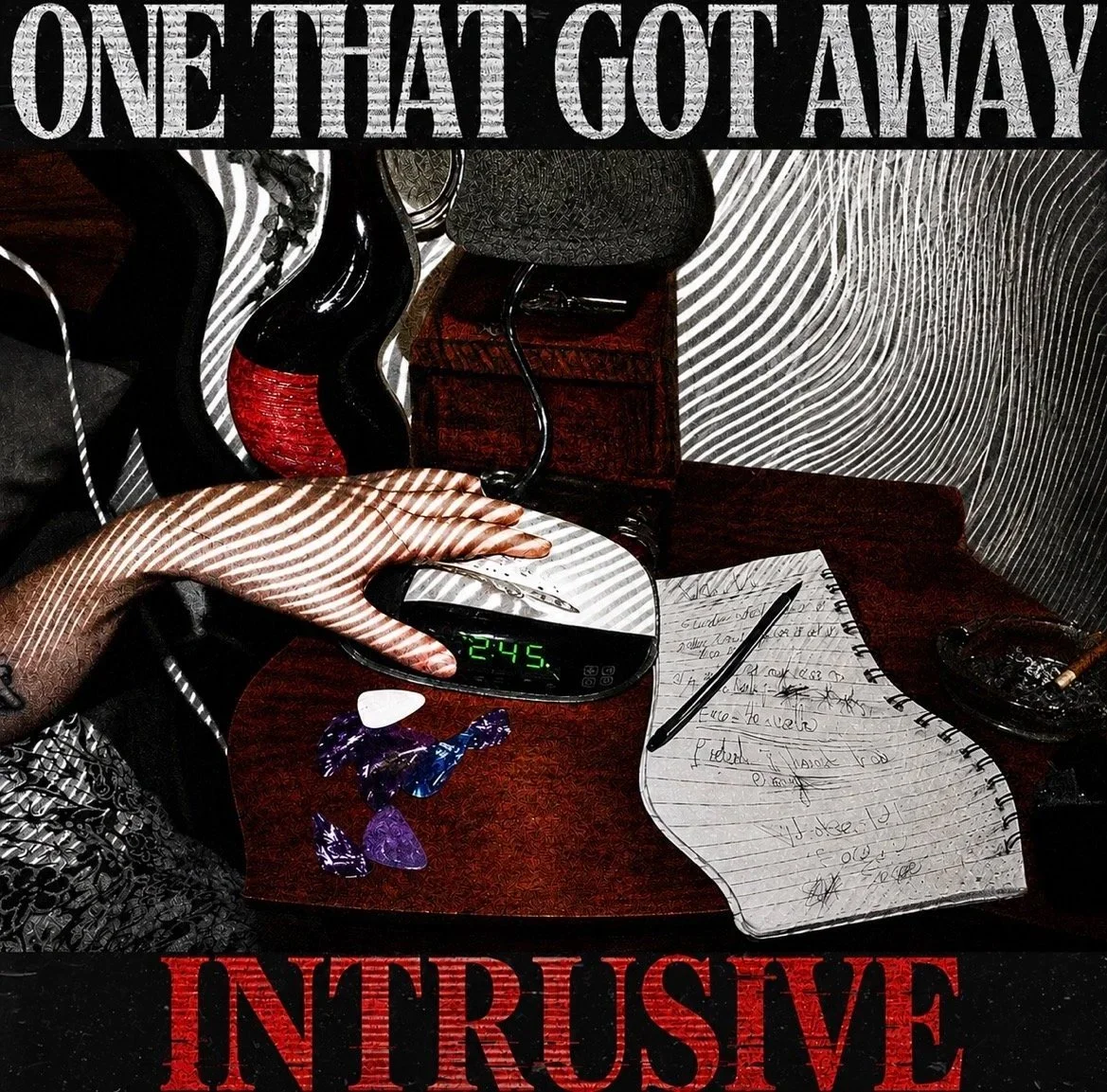
ONE THAT GOT AWAY
Intrusive · 2026
7 Tracks •INT• Records Ltd
1. Project Overview and Rationale
My major project involved the planning, production and independent release of One That Got Away, the debut album by my band, Intrusive. The album was released through •INT• Records Ltd, a record label established by myself and the other members of the band. The project therefore combined creative production with artist management, entrepreneurship, collaboration, marketing, live-event organisation and independent music distribution.
My chosen discipline was independent music-business practice, particularly artist management, label operations, release strategy and live-event development; music production provided the professional product through which those business functions were tested.
The idea of producing an album developed at approximately the same time as establishing an independent record label in early 2026.
The Professional Collaboration module provided the initial foundation for this idea. During that trimester, I discussed the proposal extensively with my tutor, Chris, before receiving approval to develop it further. The label was subsequently established during the previous trimester, allowing the album to become the next practical stage of its development.
I chose to centre the project on Intrusive because, earlier in the master's course, I was asked what I would continue doing regardless of whether I was studying at university. My answer was that I would still be developing the band. Intrusive was already performing approximately three times each month, securing stronger opportunities and generating more income. We had released three singles that I had produced and mixed, but our recorded catalogue did not fully represent our development as a live band. Instead of releasing further isolated singles, an album could provide a more complete representation of our identity and better match the venues, collaborators and audiences we were beginning to reach.
The project also reflected my career interests. Although I perform as the band's drummer, I lead much of its management, administration, social media, planning and external communication. Establishing •INT• Records allowed me to combine this experience with the knowledge and mentorship available through the Music Business master's course. At its core, the project was about independence: rather than waiting for another organisation to create opportunities for us, we wanted to develop the structure and skills required to make them ourselves.
Success was initially defined mainly through execution. The principal aims were to establish the label, complete and release the album, coordinate its live and promotional activity, and demonstrate that I could manage a complex project involving band members, collaborators and third parties. August was chosen as the release period so that the album could conclude our summer run of performances while remaining recent enough to evaluate within the submission. The project did not receive university funding. Following a mentorship call with Duncan, I was advised to begin at a manageable scale and develop a strong foundation before pursuing larger funding opportunities.
2. Methodology and Process
2.1 Project Development and Early Collaboration
Although the major project was not fully defined at the beginning of 2026, its central idea was approved in principle in approximately February. This developed directly from the Professional Collaboration module, during which I began exploring the possibility of establishing an independent record label. Following several discussions with Chris, we agreed that creating the label and using it to produce and release an Intrusive album represented an appropriate level of ambition for the major project. This meant that the work completed during Professional Collaboration became the foundation for the later project rather than remaining a separate academic exercise.
The album also built on professional relationships established before the project formally began. In July 2025, Intrusive recorded three songs in one day at the Royal Birmingham Conservatoire. This opportunity was made possible by Richard Shrewsbury, a professor at the Conservatoire and a friend of the band. After seeing Intrusive perform several times, Richard wanted to support our development and personally financed the recording session. Two of the three songs were subsequently released as singles during the following year, while the third remained unreleased. Alongside an earlier recording that functioned more as a demo, these releases gave the band an initial recorded catalogue. However, the decision not to release the third song separately contributed to the idea of developing a complete album rather than continuing to release isolated singles.
The three songs recorded at the Conservatoire were “Wake Up,” “High” and “Moving On.” “High” and “Moving On” were released as singles, while “Wake Up” remained unreleased and was later chosen as the opening track on the album. This allowed material from an earlier stage of the band’s development to be placed alongside the new recordings and gave the album a wider sense of progression.
At the beginning of 2026, we began rehearsing at Cave Music Studios alongside our university rehearsals and developed a strong professional relationship with its owner, Vonj. Intrusive also performed opening sets at events connected to him. Following discussions in April, Vonj reserved full recording days across the summer. This opportunity developed through regular rehearsal, live work, trust and continued communication rather than a single enquiry.
The relationship with Vonj became important because he understood how Intrusive worked as a live band before the main album sessions began. We were therefore not entering an unfamiliar studio with an engineer who had never heard us perform. The recording arrangement grew through an existing professional relationship, and this made it easier to discuss the purpose of the album, the compressed schedule and the different approach required for each track.
2.2 Label Structure and Responsibilities
•INT• Records Ltd was incorporated in May 2026. The responsibilities connected to the album were formally treated as label responsibilities rather than informal band tasks. These had already been discussed and documented during the Professional Collaboration module through company agreements and supporting documents.
My 40% ownership reflected the larger operational responsibility I had agreed to assume, with Sam and Alfie each holding 30%. This division was openly discussed and agreed as fair between the three of us. It acknowledged that, alongside my creative role as Intrusive’s drummer, I would manage a greater proportion of the label’s administration and project delivery.
Alfie’s principal responsibility was media capture. He regularly documented rehearsals, recording sessions and live performances, creating a visual record of the album’s development without allowing filming to interfere excessively with the work itself. He also edited the majority of the band’s live photographs and supplied much of the material later used across our social-media channels.
Sam was responsible for the visual direction of the project. Having previously designed the artwork for Intrusive’s singles and the •INT• Records logo, he was tasked with developing the album cover and maintaining continuity across the label and band’s visual identity. He also supported elements of show booking and the management of performance income.
My principal responsibilities included arranging the recording sessions, negotiating rates, coordinating the live schedule, managing the wider project timetable and maintaining communication with external collaborators. I also produced, mixed and mastered the album, prepared the final files for distribution and led much of the posting, release administration and external outreach connected to the campaign.
Although these roles were clearly allocated, they were not treated as rigid boundaries. Each member contributed ideas outside his principal area, and important decisions were made collectively. The structure was intended to prevent important tasks from being overlooked while still allowing the project to benefit from the close creative relationship already established within the band.
2.3 Financial and Project Management
Following incorporation, we opened a Monzo business account for •INT• Records and transferred the band’s existing earnings into it. This separated the company’s money from our personal accounts and made it easier to monitor the financial position of the project. The account also allowed us to create separate pots for different purposes and to control the level of access available to each director.
We did not receive immediate grant or university funding for the album. Approximately half of the project expenditure was covered by money that Intrusive had already earned through live performances, while the remaining costs were met through personal contributions from the three members. We treated these contributions as money being advanced to a developing company rather than simply as casual spending on the band.
This approach allowed the album to proceed without waiting for an external funding decision, but it also increased the personal pressure attached to the project. What did relieve some financial pressure was self producing the whole album. Mixing and mastering this project myself meant that apart from paying for studio and engineering time, we saved a lot of money through the post production process. All three members worked full time alongside the album, including my own management role at Tesco. The project therefore had to be completed around employment, rehearsals, performances, birthdays, family commitments, travel and other responsibilities.
The financial structure also changed how we treated income from live performances. Payments from promoters were invoiced through •INT• Records, transferred into the business account and recorded as company income. This provided a clearer process than allowing show payments to move informally between personal accounts. It also supported the longer-term intention for the label to manage Intrusive’s commercial activity professionally.
We separated creative and business time throughout the project. Two weekly meetings were reserved for rehearsing as Intrusive, while a third meeting normally lasted between three and four hours and focused on the label, album and showcase. During these meetings, we listened to mixes, reviewed artwork, discussed recording sessions, monitored ticket promotion and held one another accountable for the tasks that had been agreed.
Maintaining this distinction became important because the three directors were also close friends and band members. The company structure allowed difficult operational conversations to take place from the perspective of •INT• Records. When the meeting ended, we could return to rehearsing and performing without every business disagreement becoming personal.
2.4 Expansion into a Label Showcase
The live event developed from an idea that had initially been considered during the Professional Collaboration module. Once •INT• Records had been incorporated, the event became an opportunity to demonstrate that the company could do more than release recorded music. It could also organise live activity, coordinate other artists and create a professional setting in which the album could be announced.
The Louisiana in Bristol was selected as the venue because it was an established grassroots space with a strong reputation for emerging music. The venue was also appropriate for the size of audience we realistically expected to attract. Organising a focused event at this level reflected the advice I had received about beginning at a manageable scale and building a strong foundation before attempting larger projects.
Contact with Zac and the Newmen developed through an existing college relationship. We had remained aware of one another’s progress, and they agreed to travel to Bristol to support Intrusive. I selected Sighthound as the opening act after performing with them earlier in the year. They were a local Bristol band, which helped connect the event to the city as well as giving another developing artist an opportunity to perform.
The order of the lineup was deliberate. Sighthound’s indie sound opened the evening, Zac and the Newmen then moved the event towards a more alternative-indie style, and Intrusive completed the progression with a heavier alternative-rock headline set. This allowed the three artists to remain compatible without presenting an evening in which every band sounded identical.
The event required communication with the venue, supporting artists and technical staff. Running orders, arrival times, soundchecks, ticket information, promotional materials and payment arrangements all needed to be agreed. The artist payment split was discussed in advance, with Intrusive receiving 50%, Zac and the Newmen 30% and Sighthound 20% of the relevant distributable income.
The showcase also created a focal point for the wider campaign. Instead of treating the album announcement, live activity and label launch as separate events, we used the Louisiana performance to connect them. The audience was able to experience Intrusive in the live environment in which the band was already strongest before being told that the album would shortly be available.
2.5 Recording Strategy and Sessions
The final album consisted of seven tracks in the following order: “Wake Up,” “Burn Time,” “High,” “Take It Back,” “Moving On,” “T.O.T.G.A (Prelude)” and “The One That Got Away.” The album itself was titled One That Got Away, without “The,” while the final title track retained the full name.
The recordings combined material from two separate periods in the band’s development. “Wake Up,” “High” and “Moving On” had been tracked at the Royal Birmingham Conservatoire in July 2025, with “High” and “Moving On” subsequently released as singles. “Wake Up” remained unreleased and was later selected as the album’s opening track. The four remaining pieces-“Burn Time,” “Take It Back,” “T.O.T.G.A (Prelude)” and “The One That Got Away”-were recorded at Cave Music Studios during the summer of 2026.
We initially reserved approximately five full recording days but completed the required material in four, allowing us to cancel the final session. The first recording took place on 14 June, one day after an Intrusive headline performance in Birmingham. During this session, we recorded “Take It Back.” Beginning the new recording phase in the middle of June created a demanding schedule because the album was intended for release in August. However, I had confidence in my ability to complete the later production, mixing and mastering work. I understood that meeting the deadline would require a highly organised and disciplined approach, particularly while balancing employment, live performances, the label showcase and the wider administration of •INT• Records.
The second session took place on 12 July, two days after a London performance, and focused on “Burn Time.” The gap between the first two sessions resulted from birthdays, travel and the members’ other commitments. Instead of repeatedly changing the studio bookings, we treated the recording dates as fixed points and arranged the rest of our schedules around them.
The third session took place on 2 August and was used to record “The One That Got Away.” The final session was held on 18 August, when we recorded the short prelude that leads into the title track. This session also functioned as the band’s final rehearsal before the •INT• Records showcase. Recording the final piece only ten days before the album’s release demonstrates how tightly compressed the production schedule had become by the end of the project.
Rather than applying exactly the same recording method to every song, we selected an approach based on the feel, tempo and arrangement of each track. For “Take It Back,” we initially recorded as a complete band to capture the energy and interaction of a live performance. The band played to a click track, after which the guitars and vocals were rerecorded or supplemented through overdubs.
“Burn Time” required a different method because of its fast tempo and drum-and-bass-influenced rhythmic style. Alfie and I recorded the bass and drums together first so that we could concentrate on locking in the rhythm section. The guitar parts were then recorded separately because they were more intricate and required additional time and precision. The vocals were added after the instrumental recording had been completed.
On one occasion, Sam was delayed at work, so Alfie and I began by recording bass and drums without him. We found that this allowed us to focus more closely on the rhythmic foundation and made the early part of the session run more smoothly. Rather than treating the delay solely as a problem, we recognised that the resulting method suited the material and deliberately applied a similar structure to later tracks. This became an example of the creative process developing in response to an unplanned event.
“The One That Got Away” was also built from drums and bass before the guitars and vocals. The opening section was recorded to a click, but a series of stabs before the central guitar solo created a natural point at which we changed approach. The second section was performed without a click to preserve the swing and movement of our live version. Vonj edited the two sections together so that the final transition felt natural.
The prelude was recorded primarily as a complete band because we wanted it to sound raw and intimate, as though the listener were hearing us playing together in a room. Additional electric guitar, acoustic guitar and vocal parts were then added to develop the arrangement without removing its informal character. This approach also helped distinguish the prelude from the larger and more heavily produced title track that followed it.
2.6 Mixing, Production and Album Cohesion
Rather than waiting until every recording session had been completed before beginning the mixes, I treated recording and mixing as overlapping stages. “Take It Back” was fully mixed by the time we returned to Cave Music Studios to record “Burn Time.” I began mixing “Burn Time” immediately after its recording session, and “The One That Got Away” was mixed on the evening after it was recorded. The prelude was deliberately mixed on the day before release because its raw sound and shorter arrangement required less detailed processing. This prevented the entire mixing workload from accumulating at the end of the project and allowed me to work while the intentions behind each session were still fresh.
A central challenge was creating cohesion between recordings made in two different studios, across two different periods and using different main drum kits. The Birmingham sessions had taken place in July 2025, whereas the Cave Music Studios recordings were completed during the summer of 2026. I did not want the listener to feel that the album was simply a collection of unrelated sessions.
Some continuity came naturally from the band’s equipment and performances. Sam and Alfie retained the pedalboards and core sounds they regularly used, while I used the same cymbals and other drum breakables. I also reinforced selected drum parts with the same layered samples. These did not replace the original recordings. They created a consistent undertone of punch while still allowing differences between rooms, microphones, instruments and performances to remain part of the album’s character.
Each song was mixed according to its own identity rather than being forced into one identical template. “Take It Back” required heavy double-tracked guitars, forceful melodic vocals and punchy drums. The arrangement was dense, so the mix needed to retain the weight of the guitars without allowing them to remove the impact of the rhythm section or obscure the vocal.
“Burn Time” required much greater separation because of the speed and detail of its rhythm. Sam’s normal amplifier and pedals initially produced a tone that masked too much of the intricate guitar performance, so we recorded through Vonj’s Marshall amplifier instead. Alfie used a largely clean DI signal, while I tuned my snare higher and used lighter sticks. The track was played without a click so that the tempo could push and pull naturally.
I used Henrik Freischlader’s Get Closer as an important reference because of the clarity with which the instruments and drums are presented. The original “Burn Time” guitar tone was too dark in relation to the other material on the album. I used detailed equalisation, editing and selective re-amping to retain Sam’s performance while improving its clarity and ensuring that the rhythmic detail remained audible.
The two-section recording of “The One That Got Away” produced a slight variation in the drum sound because the sections had been captured separately. Consistent layered samples helped balance the two sections without attempting to remove their natural differences completely. The change in feel remained important to the movement of the track, particularly because the second section had been performed without a click.
The outro was quad-tracked to create a wall of guitars and make the conclusion feel larger than the earlier sections. This production decision also supported the lyrical development of the song. The track moves from uncertainty and hesitation towards a more final statement, so the increase in scale helped the recording communicate that progression.
“T.O.T.G.A (Prelude)” was treated differently from the rest of the album. The aim was to retain the feeling of a raw band performance rather than making it sound as controlled as the larger tracks. The recording relied more heavily on the room sound and used fewer close microphones. Additional electric guitar, acoustic guitar and vocal parts developed the arrangement without removing its informal, almost demo-like quality.
I used ocean audio that I had previously recorded and added a layer of vinyl crackle to create an emotional reset before the final title track. I considered creating a seamless crossfade between the prelude and “The One That Got Away.” However, this would have placed part of the following song at the end of the prelude and weakened it when heard independently. I therefore allowed the prelude to ring out before a sudden clean cut, after which the title track fades in.
2.7 Mastering, Sequencing and Distribution
I retained the existing versions of “High” and “Moving On” so that they could remain linked to their original ISRCs and existing streaming data. Replacing those masters would have risked separating the album versions from the singles that listeners had already saved and streamed. The new material was therefore mastered to sit alongside the two existing tracks rather than requiring every song to be rebuilt from the beginning.
The new material was mastered using the same proprietary approach that has gradually become part of Intrusive’s recorded sound. Much of my work uses Brainworx and other Plugin Alliance software, although I chose not to disclose the complete chain. This reflects the fact that the exact combination of processing forms part of the technical method I have developed through producing and mastering the band’s releases.
I did not attempt to force every track towards one identical tonal balance or loudness. “High” was deliberately bassier because its identity depends heavily on groove, while “Moving On” prioritised warmth, body and punch. Making both tracks sound completely neutral would have removed qualities that were already central to their arrangements.
Using Metric AB, I compared each of the new masters directly with “High” and “Moving On.” This allowed me to evaluate broad tonal balance, perceived loudness and the way each track responded when placed immediately beside the existing releases. The complete album averaged approximately -7 LUFS, although some tracks pushed harder while others retained more space. The objective was to achieve a competitive level without removing the impact and musical dynamics of the performances.
After mastering, I imported all seven final files into a separate Logic Pro project. This project was used to adjust the start and end points, create the required fades and decide the length of the silences between tracks. I did not apply further tonal processing at this stage because the purpose was to evaluate the album as one complete listening experience rather than reopen the individual masters.
The running order was designed as an emotional arc. The comparatively narrow and quiet introduction to “Wake Up” suddenly expands into the full stereo field, creating an immediate opening impact. “Burn Time” then sustains the momentum. “High” provides a groove-led release, but its building outro leads into the lower-tuned and more serious “Take It Back.” “Moving On” then fades through a tape-like sound into silence, allowing the prelude to reset the listener before the final title track.
The final package was uploaded to DistroKid on Wednesday 26 August for release at midnight on Friday 28 August. The existing ISRCs were entered for “High” and “Moving On” so that these tracks could remain connected to their earlier releases. DistroKid initially displayed the album and single versions separately while processing the link, but the delivery otherwise proceeded smoothly and the album appeared on schedule.
2.8 Visual Identity and Album Artwork
Sam developed the album artwork throughout the recording process. For much of this period, I gave him the independence to explore his ideas without reviewing every stage. Our meetings were already heavily focused on completing the recordings, listening to the latest mixes and organising the label showcase, which had been arranged in early June. The band was also performing at several other shows around the country, meaning that immediate operational priorities often took precedence over detailed artwork discussions.
Approximately two weeks before the showcase, we began reviewing the artwork and debating how the final design might be received. This process was closely connected to naming the album. For a period, the intended title was Don’t Ask Why, taken from a lyric in “The One That Got Away.” However, we collectively decided that this sounded too familiar, slightly corny and reminiscent of an established Oasis-style aesthetic. More importantly, we did not feel that it represented the complete range of material on the album or created enough intrigue from a marketing perspective.
We eventually selected One That Got Away. The phrase felt more open-ended and encouraged the potential listener to question what story was behind it. Once the title was agreed, Sam was able to refine the visual concept more clearly. The design he presented at this stage was already close to the version that was eventually released, although Sam, Alfie and I each contributed ideas and feedback before reaching the final decision.
My alternative concept was a sketched or painted image of a city at night, surrounded by rain and traffic, with the album title appearing across the sky. This was influenced by the lyric “I’m in a city with a dying wish” from the title track. Initially, I strongly preferred this darker and more cinematic direction. However, Sam identified that Intrusive’s previous releases had already used predominantly dark artwork and colour palettes, regardless of the individual designs. He proposed that the album should instead be brighter, more vibrant and immediately eye-catching. This was particularly relevant because we intended to have the album physically pressed in the future.
Sam’s argument changed my perspective on the artwork. We also recognised that a darker and more detailed cover could create expectations that every track would be equally serious or stylistically similar. A simpler and more colourful design placed fewer restrictions on how a new listener might interpret the music before hearing it.
The final cover showed Sam’s hand reaching towards an alarm clock displaying quarter to three. This referenced the “Wake Up” lyric, “Stumble out of bed at quarter to three,” while also connecting naturally to the album’s opening track. The image contained several smaller Easter eggs, including guitar picks and a sketchbook containing lyrics from “Wake Up.” The use of the hand also created visual continuity with the artwork for “Moving On.”
The design therefore appeared simple and direct at first glance while rewarding closer attention. During the final editing process, we reduced some of the effects that had initially made the image feel overly processed and cleaned the design until it retained its vibrancy without becoming visually excessive.
The final artwork also supported several possible interpretations of the record. It could represent someone waking up and continuing with everyday life, someone recovering after having too much fun the previous night, or someone repeatedly getting up to pursue a creative ambition despite exhaustion or uncertainty. This final interpretation connected particularly well with the title track and with our own experience of continuing to build the band while balancing employment, study and other responsibilities.
2.9 Showcase-Led Marketing and Release Campaign
We began loosely promoting the album approximately one month before its release, although we deliberately avoided launching an intensive campaign too early. Our main promotional focus remained the Louisiana showcase. Online, we teased that new material was approaching through TikTok content, captions and occasional comments, but we did not immediately reveal the complete album campaign.
This was a deliberate decision informed by our experience of promoting earlier singles. We had found that announcing music too far in advance could create a brief period of interest that disappeared before the release became available. Repeatedly promoting an unavailable product also risked creating audience fatigue. Our alternative strategy was to concentrate interest within a shorter period and ensure that listeners could access the music soon after discovering it.
The showcase was central to this approach. Our immediate objective was to bring as many people as possible into the Louisiana, and the event was very well attended. We used the performance to announce the album formally to an audience that had already demonstrated an active interest in Intrusive by attending the show. These people were among those most likely to listen to the album immediately, share it with others and continue following the band.
The live setting also allowed the audience to experience the songs in the form for which Intrusive was already best known. After seeing the band perform, listeners were told that they would soon be able to access the material wherever they normally consumed music. We then supported the live announcement with online posts during the short period before release. This meant that people encountering the announcement did not have to maintain their interest for several weeks before hearing the finished album.
The initial response supported the value of this strategy. People who attended the show asked us about the release, discussed it with friends and shared the later announcement posts. The campaign therefore combined live engagement, word-of-mouth activity and social-media promotion rather than relying exclusively on repeated digital advertising.
Our experience with previous releases had also suggested that post-release promotion worked more effectively for Intrusive than a long pre-release campaign. Once the album was available, every new post, video or conversation could direct the audience immediately towards a finished product. We therefore intended the release date to act as the beginning of the main promotional campaign rather than its conclusion.
Just prior and following the release, I began an intensive period of radio, press and editorial outreach. Some platforms, including BBC Introducing, required the music to be publicly available or submitted through a particular system, meaning that parts of the campaign could only begin once the album had been released. I contacted radio stations, magazines and music platforms across Bristol, Cardiff and the wider South West, including BBC Introducing, BCfm, Bristol Music, Bristol Music Weekly, Bristol24/7, Corn Magazine, Louder Than War, Echoes and Dust and Emerging Rock Bands.
This outreach involved identifying relevant contacts, adapting submissions for different platforms, providing suitable audio formats and beginning longer-term professional conversations rather than sending one identical message to every outlet. At the time of writing, this process remains ongoing. The purpose is not only to secure immediate coverage for One That Got Away, but also to establish relationships that may support later Intrusive and •INT• Records releases as the album’s streaming activity continues to develop.
2.10 Relationship to Current Industry Practice
Viewed through a music-business lens, the project reflects the contemporary DIY artist model described by Oliver (2024), in which digital tools provide greater autonomy while transferring responsibility for marketing, finance and commercial sustainability to the artist. Establishing •INT• Records increased our control over the album, but the personal contributions, workload and dependence on digital platforms also exposed the risks associated with that independence.
The project also operated across three of the four commercial assets identified by UK Music (2026): recorded music, live performance, and brand and image. Rather than treating these as separate activities, the album, visual identity and showcase were designed to strengthen one another. Prioritising digital distribution was consistent with a global recorded-music market in which streaming generated 69.6% of revenue during 2025 (IFPI, 2026). However, the album’s early 2,000 streams should be understood as initial engagement rather than evidence of commercial sustainability. Longer-term listener retention, income, geographic data and conversion into ticket sales will be required before the campaign’s full business impact can be evaluated.
The use of Spotify Canvas provided another example of the project engaging with current digital-release practice. For most tracks on the album, I selected looping footage captured during the •INT• Records showcase at the Louisiana. This was a deliberate decision rather than simply reusing available video: the event was the first live showcase organised through the label, while One That Got Away was its first album release. Connecting the two through Spotify created continuity between the label’s live and recorded activity and extended the campaign’s visual identity into the listening experience. It also allowed listeners discovering the album digitally to see the songs performed within the live environment where the record had been formally announced.
3. Critical Reflection
3.1 Evidence of Success
The project achieved its main creative and operational objectives. •INT• Records was established as a functioning company, Intrusive completed and independently released a seven-track album, and the label organised its first live showcase. These outcomes are particularly significant because the recording, mixing, mastering, artwork, distribution, marketing and event management were completed alongside full-time employment and an active schedule of live performances.
The Louisiana showcase provided one of the clearest early measurements of success. Fifty-five tickets were sold in advance, with an estimated total attendance of between 65 and 70 people. Advance tickets were priced at £5, while entry on the door was approximately £8. Assuming that the additional attendees paid the estimated door price, the event produced approximately £355–£395 in gross face-value ticket income before any fees or deductions. This figure remains provisional because •INT• Records is awaiting the venue’s complete spreadsheet of ticket sales and revenue.
The artist payment split had been agreed before the event, with Intrusive receiving 50%, Zac and the Newmen receiving 30% and Sighthound receiving 20% of the relevant distributable income. Once the final settlement is received, •INT• Records will be able to complete the payments and account for the event accurately. This administrative process demonstrates that the label is operating as a company rather than treating show income informally. Payments from promoters are invoiced through •INT• Records, recorded through the business account and then distributed according to the agreements made in advance.
The showcase was also part of a wider live campaign. Intrusive performed at the Louisiana on Friday 21 August, travelled to Leicester for another performance on Sunday 23 August and then played in Bath on Monday 24 August. These additional dates allowed different regional audiences to engage with the band during the album campaign. People familiar with our Birmingham performances had another opportunity to see us in Leicester, while the Bath show provided an alternative for local listeners who had been unable to attend the Louisiana.
The album itself exceeded 2,000 streams within its first two days. This represents a positive early response, particularly because the principal promotional campaign was designed to begin at release rather than end there. At the time of writing, the album has not yet received any confirmed playlist placements, although its streaming figures, saves and other engagement data are still developing. It would therefore be premature to judge the album’s longer-term commercial performance from only its first two days. A more reliable evaluation will require figures gathered across several weeks or months.
3.2 What Worked
The strongest aspect of the project was the level of professionalism and communication maintained between the members. During the Professional Collaboration module, I considered how placing a formal business structure around the band’s commercial activity might help protect its creative relationship. This project provided practical evidence that this idea could work.
Clearly assigned company roles made it possible to hold one another accountable without turning every band disagreement into a personal issue. Responsibilities involving finance, media, artwork, recording, distribution and project management could be discussed from the perspective of •INT• Records. When it was time to rehearse or perform, those administrative concerns could be set aside, allowing us to return to being close friends and musicians. The formal structure did not weaken the friendship within the band; it helped create a healthier boundary around its business activity.
Our existing friendship and musical chemistry were equally important. The project required late studio sessions, early starts, repeated rehearsals, personal financial contributions and significant work outside our normal employment. Each member remained committed because we shared a belief in the album and regarded it as the beginning of a new stage for both Intrusive and •INT• Records. This collective belief made the workload more sustainable, even when it remained demanding.
Communication with external collaborators also contributed to the project’s success. Our relationships with Richard Shrewsbury and Vonj created recording opportunities, while communication with the Louisiana, Zac and the Newmen and Sighthound allowed us to organise a professionally structured event. The project demonstrated that independent activity still depends heavily on collaboration, trust and maintaining positive working relationships.
The showcase-led marketing strategy also worked effectively for the immediate aims of the campaign. Paid Instagram advertising supported the event, but much of the promotion required little direct expenditure. We personally contacted potential attendees, encouraged word-of-mouth promotion and benefited from audience members bringing friends. Although the band did not have enough time to busk together, Sam attended open-mic events, performed acoustic versions of Intrusive songs and invited people to the showcase.
It is difficult to attribute individual ticket sales to one promotional method because advertising, direct messages, live appearances and personal recommendations were used simultaneously. However, the strong attendance suggests that their combined effect was successful. The live announcement also gave the album an engaged initial audience, contributing to its early streaming response.
3.3 Challenges and Limitations
The greatest source of stress was the compressed schedule. Recording began on the 14th June, the final prelude was recorded on the 18th of August, the showcase took place on 21 August, and the completed album was delivered to DistroKid on 26th of August for release on the 28th August. Although every deadline was met, the schedule offered very little contingency for illness, technical problems, rejected files or unexpected changes.
This pressure was intensified by commitments outside the project. All three members worked alongside the band, while summer also brought birthdays, family visits, holidays, travel and an extensive performance schedule. From my own perspective, maintaining the required discipline was sometimes difficult. However, the project remained personally meaningful, so the work felt connected to a long-term ambition.
The final three weeks before the showcase required a particularly intensive push for ticket sales. This overlapped with the period in which I was completing the newest mixes and preparing the final masters. Although the promotion ultimately produced the intended attendance, beginning the showcase campaign earlier could have reduced this pressure and protected more time for the production work. The lack of time also prevented the full band from using busking as an additional promotional method.
The financial results are not yet fully measurable because several August performances remain in the settlement process. The Louisiana showcase generated meaningful gross income, but the label cannot calculate its final net position until the venue supplies the complete figures and •INT• Records invoices accordingly. Similarly, the album’s lack of playlist placements after two days should not be interpreted as a failure, but it shows that the project’s longer-term reach cannot be measured at the point of submission.
3.4 Learning and Future Improvement
If I repeated the project, I would begin recording during the Professional Collaboration trimester rather than waiting until that module and the label setup had been completed. At the time, separating the two stages felt sensible because it allowed me to focus on establishing the company. In retrospect, beginning even part of the recording process earlier would have created more breathing room during the summer and reduced the risks associated with such a compressed final schedule.
I would also begin promoting the showcase earlier. The final campaign was effective, but its concentration within the last three weeks placed unnecessary pressure on the same period needed for mixing and mastering. A longer event campaign could retain the focused album-release strategy while spreading the work required to sell tickets.
The project confirmed that our technical skills and studio experience are strong enough to deliver work under pressure. However, the fact that we succeeded does not mean that the timetable was ideal. Greater contingency would have allowed more time for reflection, quality control and unexpected problems without reducing the ambition of the project.
Overall, the album and showcase produced the results we intended. More importantly, the process demonstrated that the label structure could support the band creatively, professionally and financially. I learned that independence does not mean completing everything alone; it means building the skills, systems and professional relationships required to take responsibility for a project and carry it through to completion.
4. Conclusion and Future Plans
The release of One That Got Away represents the beginning of the album campaign rather than its conclusion. Our immediate priority is to promote the record to radio stations, playlist curators and more established bands. The purpose is to use the album as evidence of Intrusive’s creative and professional development and place the band in a stronger position to access larger opportunities over the coming months and into the new year.
Intrusive appears to be approaching a point where the band can begin progressing beyond repeatedly playing the same grassroots circuit. This position has only been reached through the support of audiences, promoters and the other bands with whom we have developed relationships. We are now receiving interest from listeners in cities including Birmingham, London and Brighton. Live performance has created much of this demand, but recorded music has also allowed people to discover the band outside the places in which we have already performed. The album gives these songs the opportunity to reach further through radio, editorial coverage, playlists and continued word-of-mouth promotion.
Artist-curated playlists are another part of this strategy. Several larger bands within our network maintain playlists containing music they personally enjoy. These playlists are followed by fans who want to discover the influences and listening habits of those artists. Securing placements of this kind could introduce Intrusive to highly relevant audiences through a more personal form of recommendation.
Live activity will continue alongside the album campaign. The band has September performances planned at The Pump in Trowbridge and in London, while further dates are being developed for November, December and the new year. The Louisiana showcase proved that •INT• Records could organise a well-attended event, and the next stage is to develop that model further. Future showcases will not always position Intrusive as the headline act. The label could instead bring larger bands into the area and place Intrusive as an opening act or main support. This would allow •INT• Records to create opportunities for the band without making every event entirely about us.
The showcase has already produced further collaboration. I have remained in contact with the drummer from Zac and the Newmen, who also manages an emerging South Wales band called Akimbo. We are arranging a call to discuss show swaps and potential tour dates for the new year. This could involve Akimbo travelling to support us while Intrusive returns to South Wales to support them. It would increase our activity in the area where the band originated while allowing both artists to reach new audiences.
My long-term ambition is for •INT• Records to become known as the company that helped build Intrusive while also developing an identity of its own. This is why the company was not named directly after the band. Although Intrusive will remain central to its work, the intention is eventually to support releases, events and development opportunities for other artists. The community of bands and professionals we are currently building around the label could become the foundation for this expansion.
The project has not fundamentally changed my career ambitions, it has strengthened them by demonstrating that they are achievable. We established a company, completed an album, organised a showcase and released the finished work independently. The next challenge is to scale this activity and improve the process each time it is repeated. The mindset Intrusive applies to every rehearsal and performance-playing as if it were our last, in turn pushing ourselves harder each time-must now be applied equally to the label’s operational work.
In addition to developing •INT• Records, I would like to expand my work in artist management, production, mixing and mastering. Producing this album allowed me to develop my technical skills while confirming how much I enjoy shaping recorded music. Establishing myself as a reliable mixing and mastering engineer within the local scene could provide another professional route, while the label may eventually create opportunities to produce or manage other bands.
•INT• Records is currently exploring funding through PRS Foundation and Arts Council England. Subject to the conditions of any award, this funding could reduce the company’s reliance on personal contributions and support larger showcases, venue hire and more ambitious future projects. Although these projects may benefit Intrusive, the funding would be pursued by the label to build a sustainable platform capable of creating opportunities for a wider community of artists.
References
IFPI (2026) ‘Global Music Report 2026: Global recorded music revenues grow 6.4% as record companies drive innovation’. Available at: https://www.ifpi.org/global-music-report-2026-global-recorded-music-revenues-grow-6-4-as-record-companies-drive-innovation/(Accessed: 31 August 2026).
Oliver, P.G. (2024) ‘Digital transformation and the DIY artist: Balancing artistic integrity and economic sustainability in the digital domain’, DIY, Alternative Cultures & Society, 2(2). doi: 10.1177/27538702241251886.
UK Music (2026) ‘The Four Commercial Assets: Inside the Economics of the Music Industry’. Available at:https://www.ukmusic.org/news/the-four-commercial-assets-inside-the-economics-of-the-music-industry/(Accessed: 31 August 2026).
Evidence Gallery
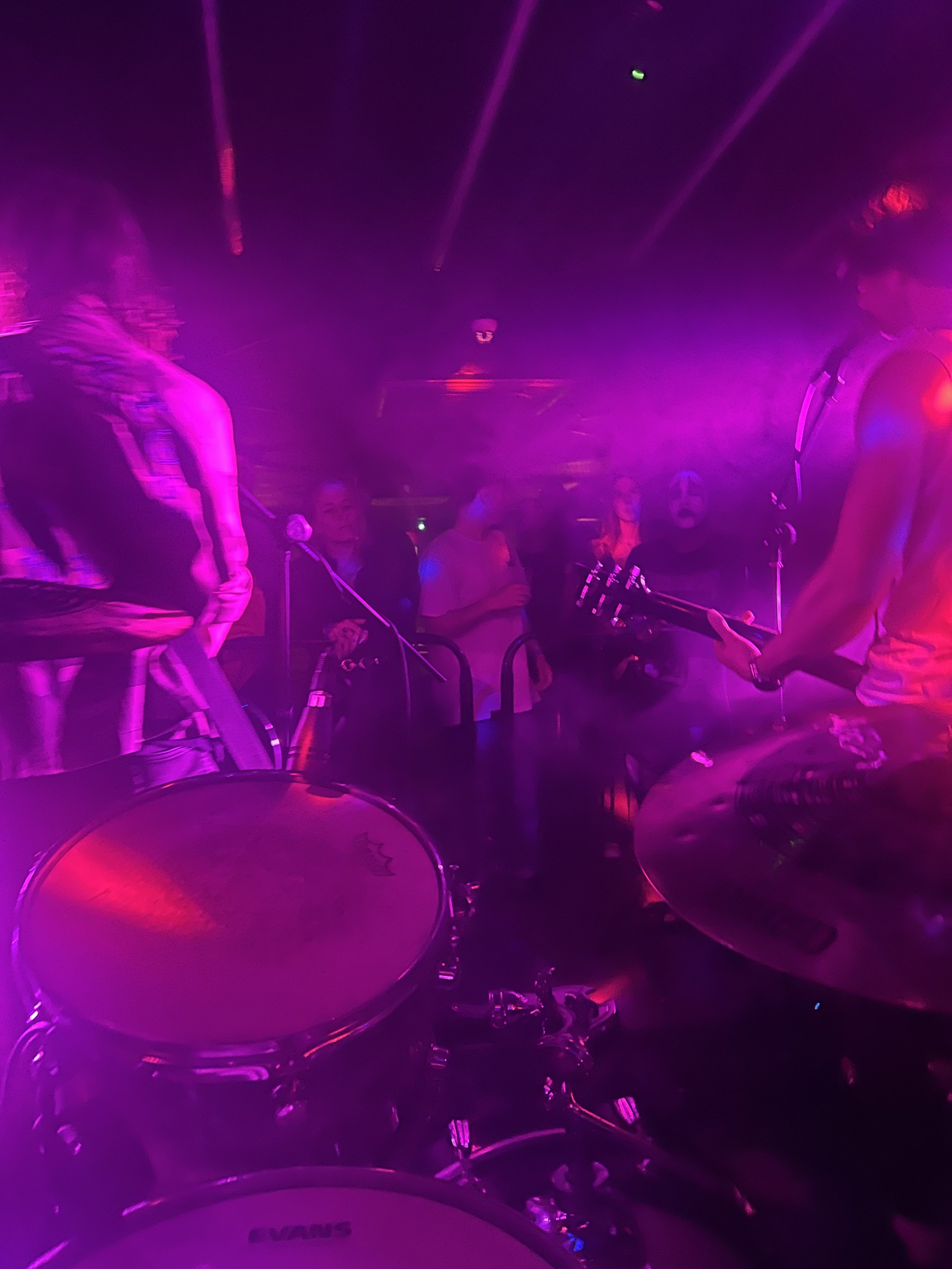
A Photo I Took From Behind The Kit In Birmingham The Day Before Our First Recording Session
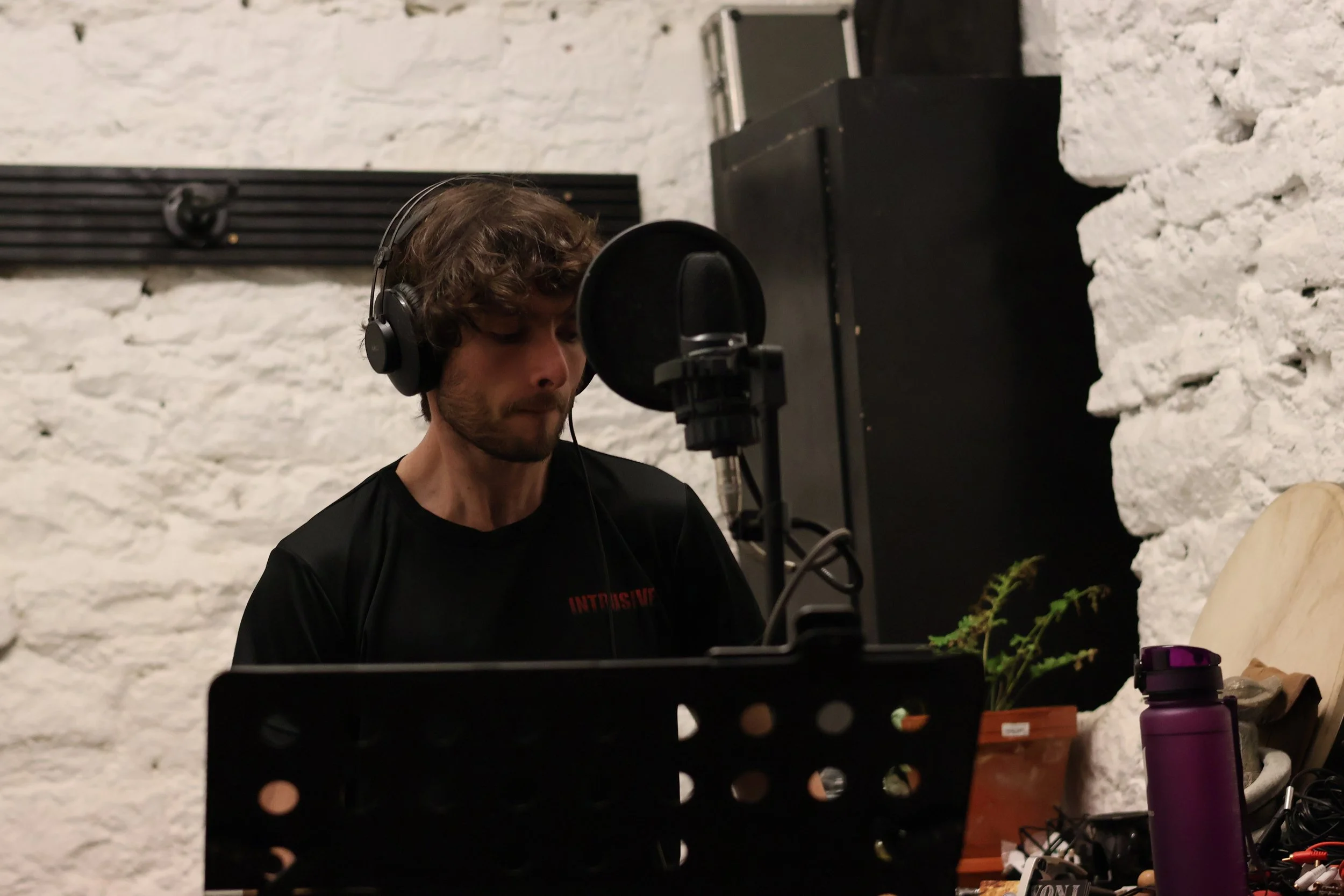
Sam During Our First Session
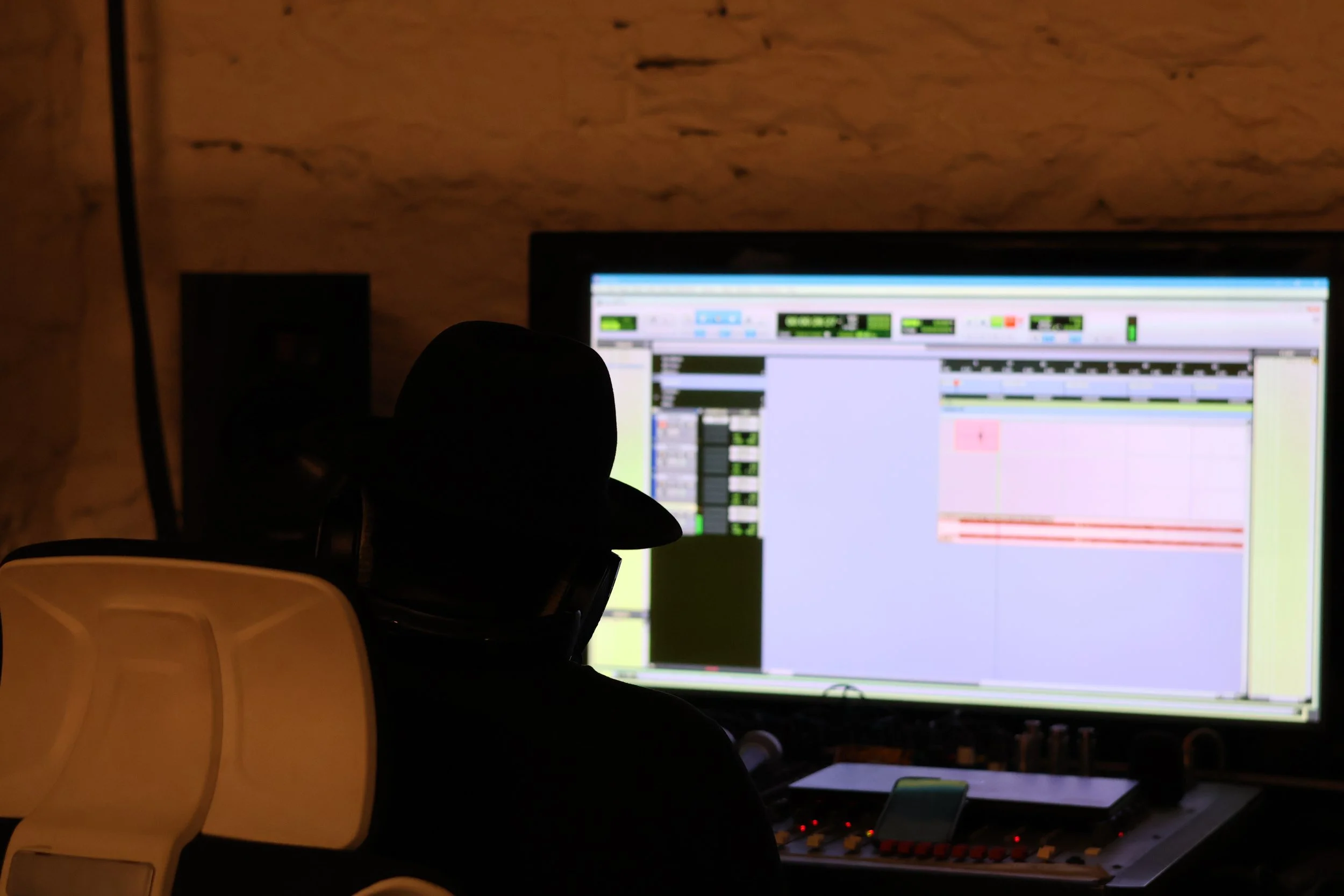
Vonj Behind The Desk
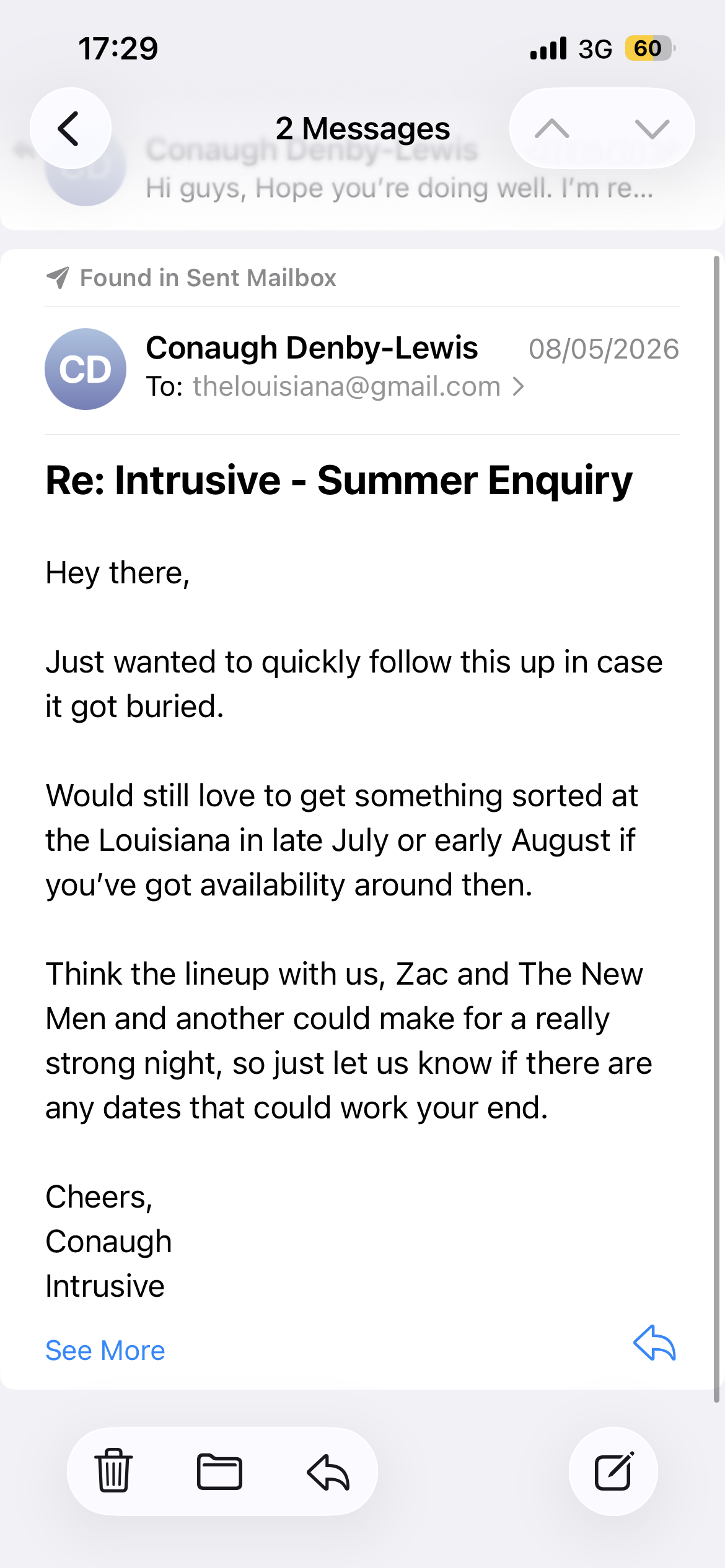
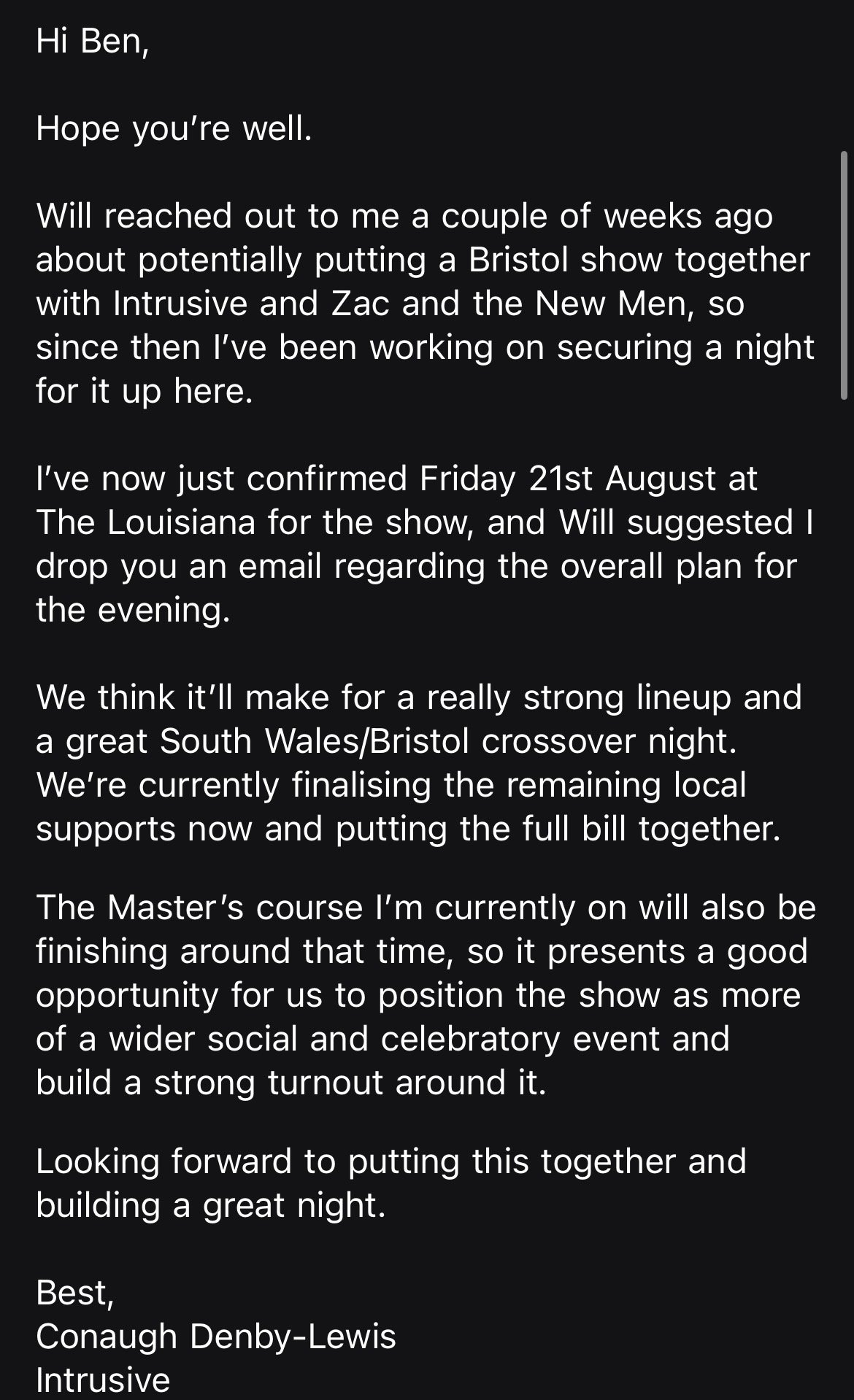
Email Chain Started With The Louisiana After Enquiring
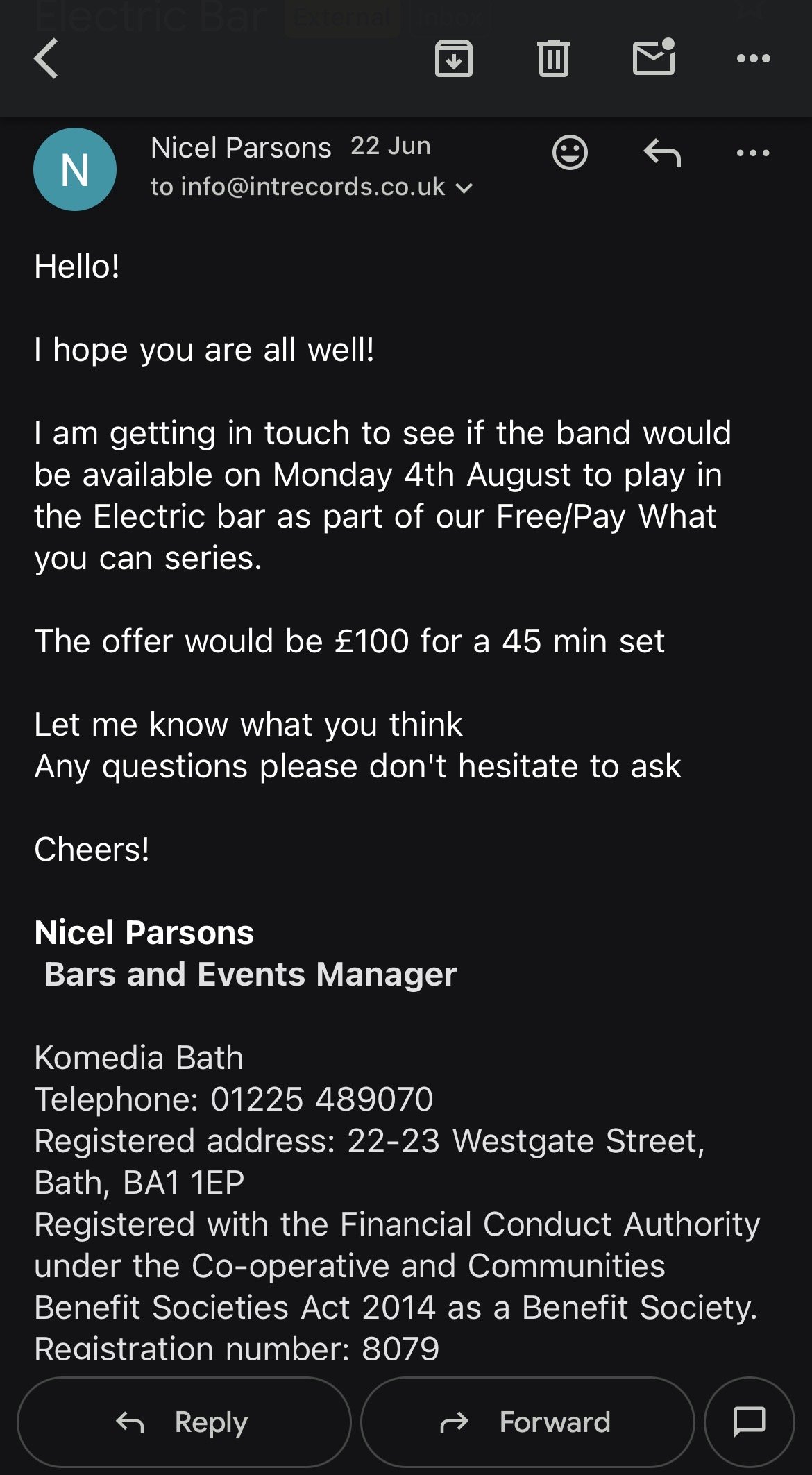
More Show Opportunities In The Works For Around The Albums Release (This Date Was Later Changed To The 24th)
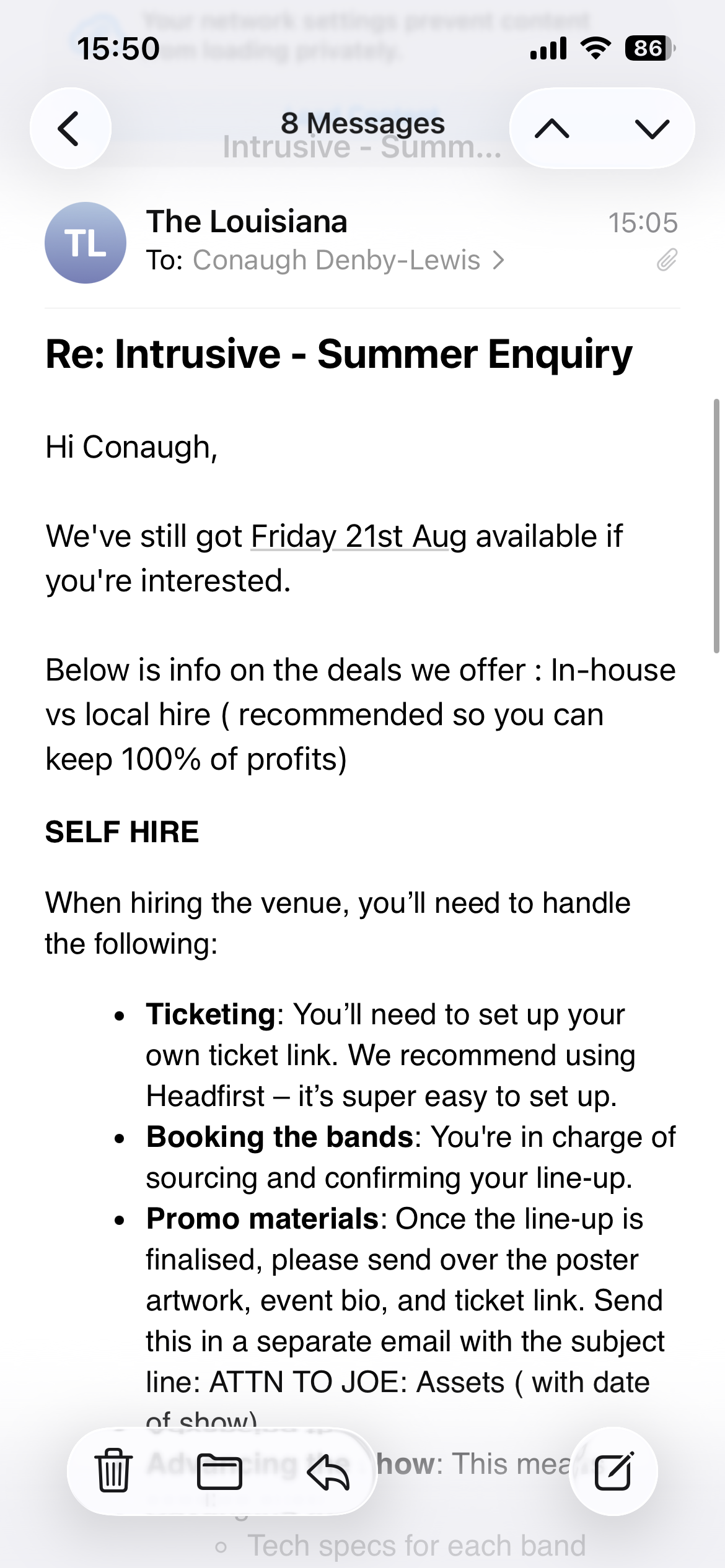
Agreeing On Date Of Showcase
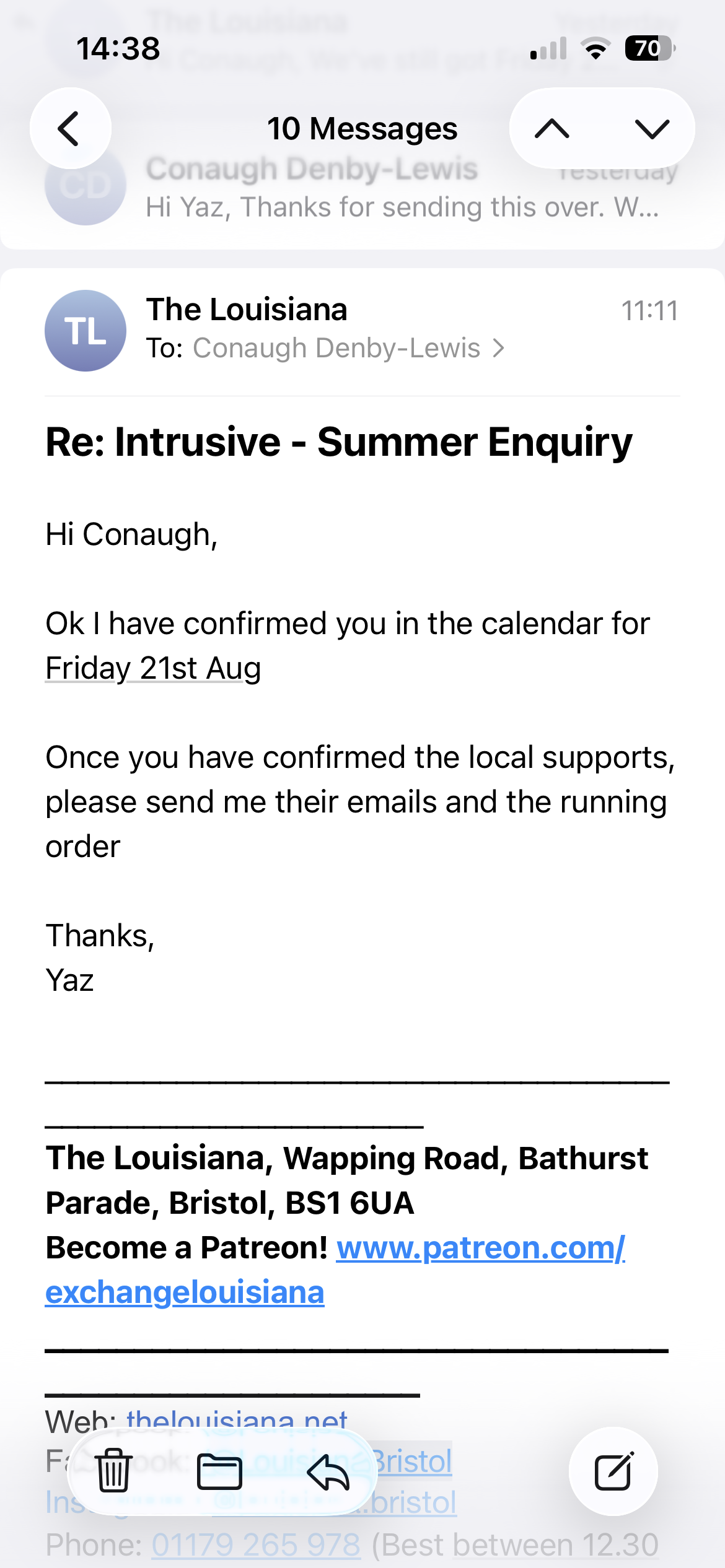
Confirming Everything
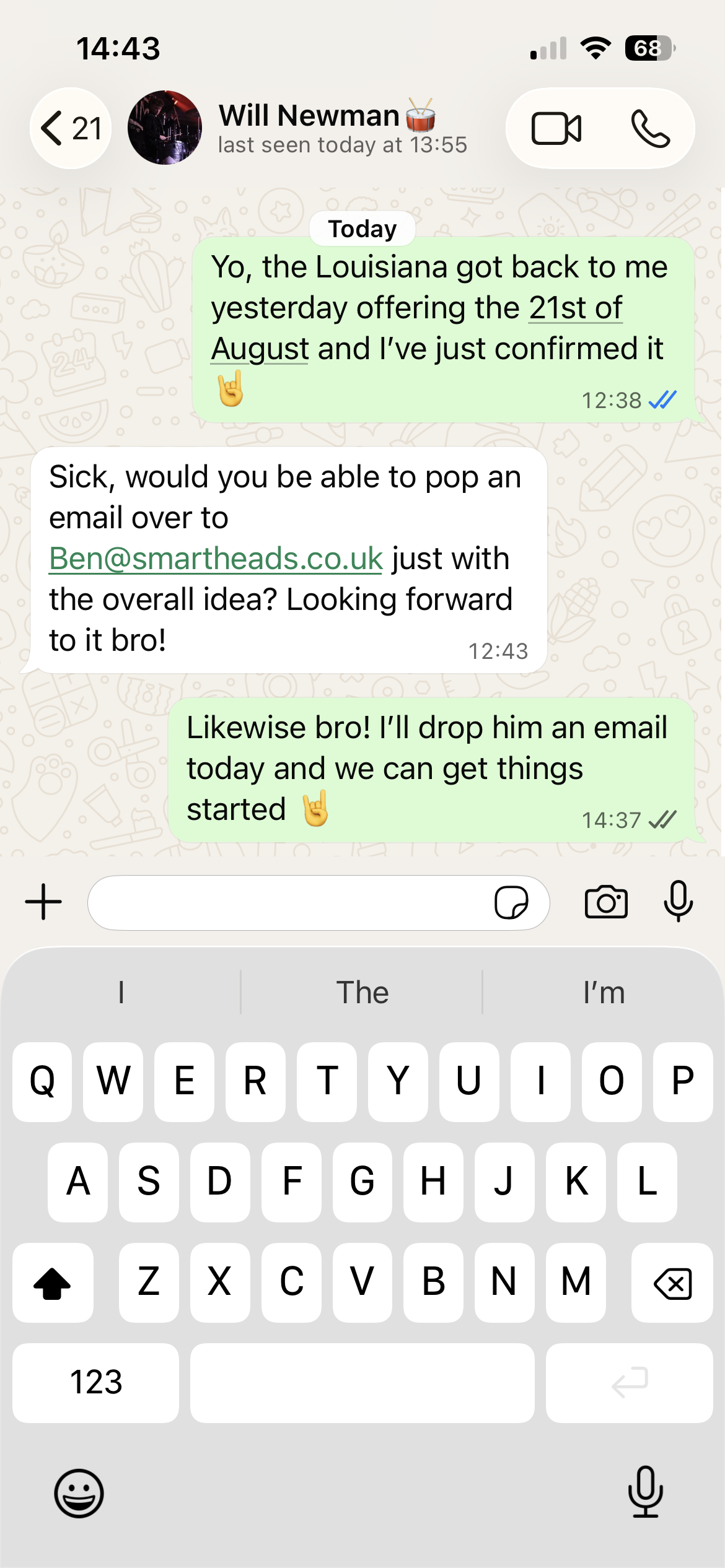
Myself And Will From Zac And The Newmen Discussing The Label Showcase
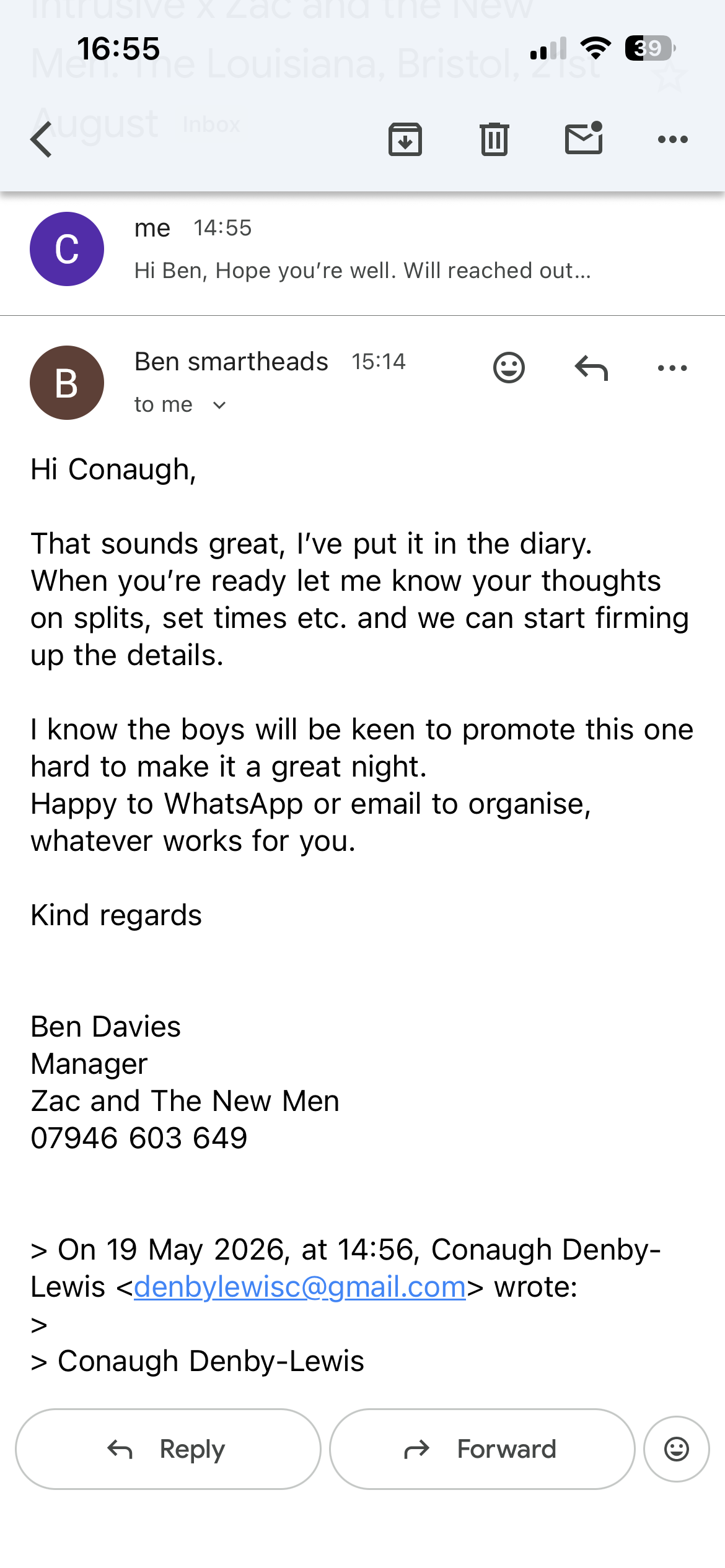
Catching Up Zac And The Newmens Manager On The Whole Idea And Plan
Email Chain Started
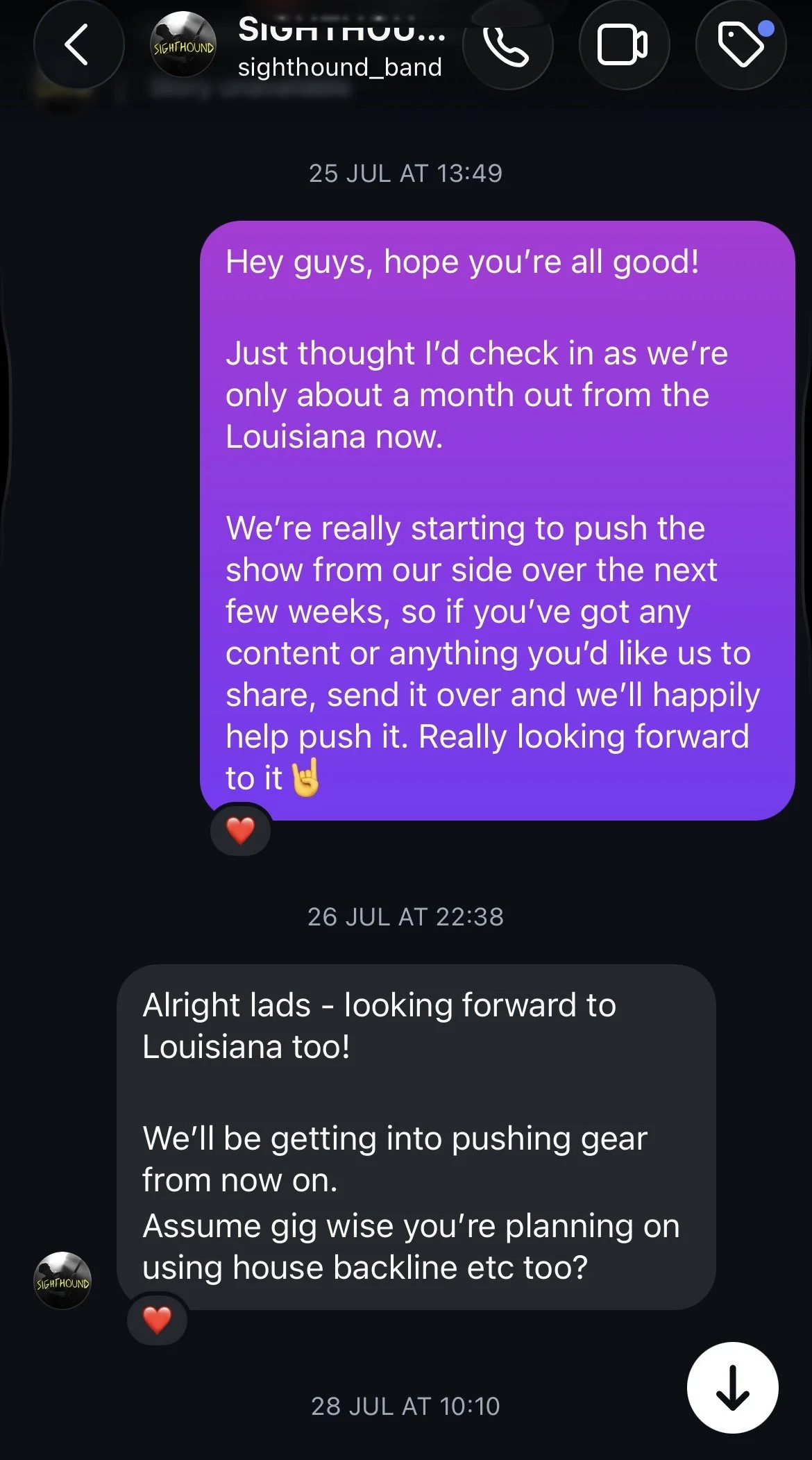
Keeping The Opener For The Evening Sighthound In The Loop And Getting Them To Push Sales
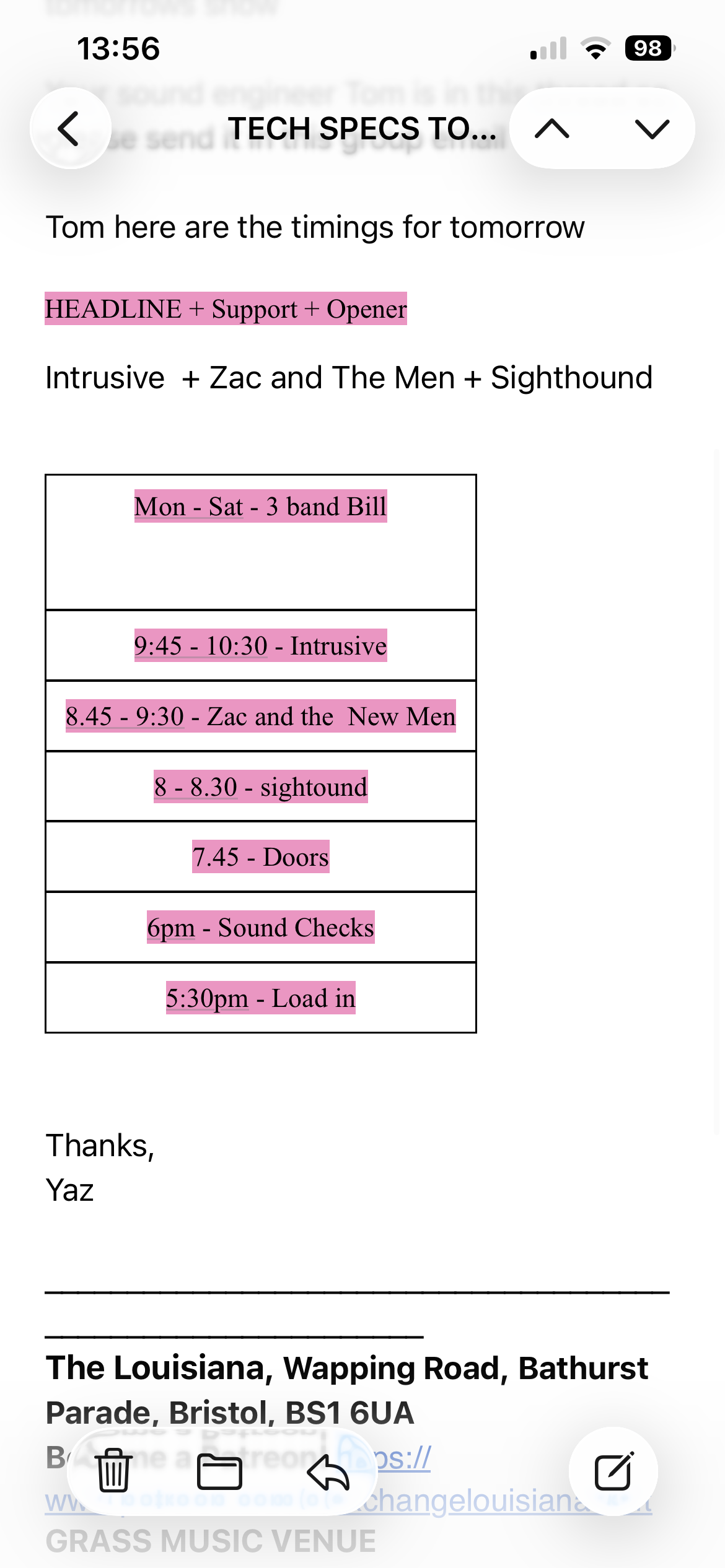
The Evenings Final Running Order
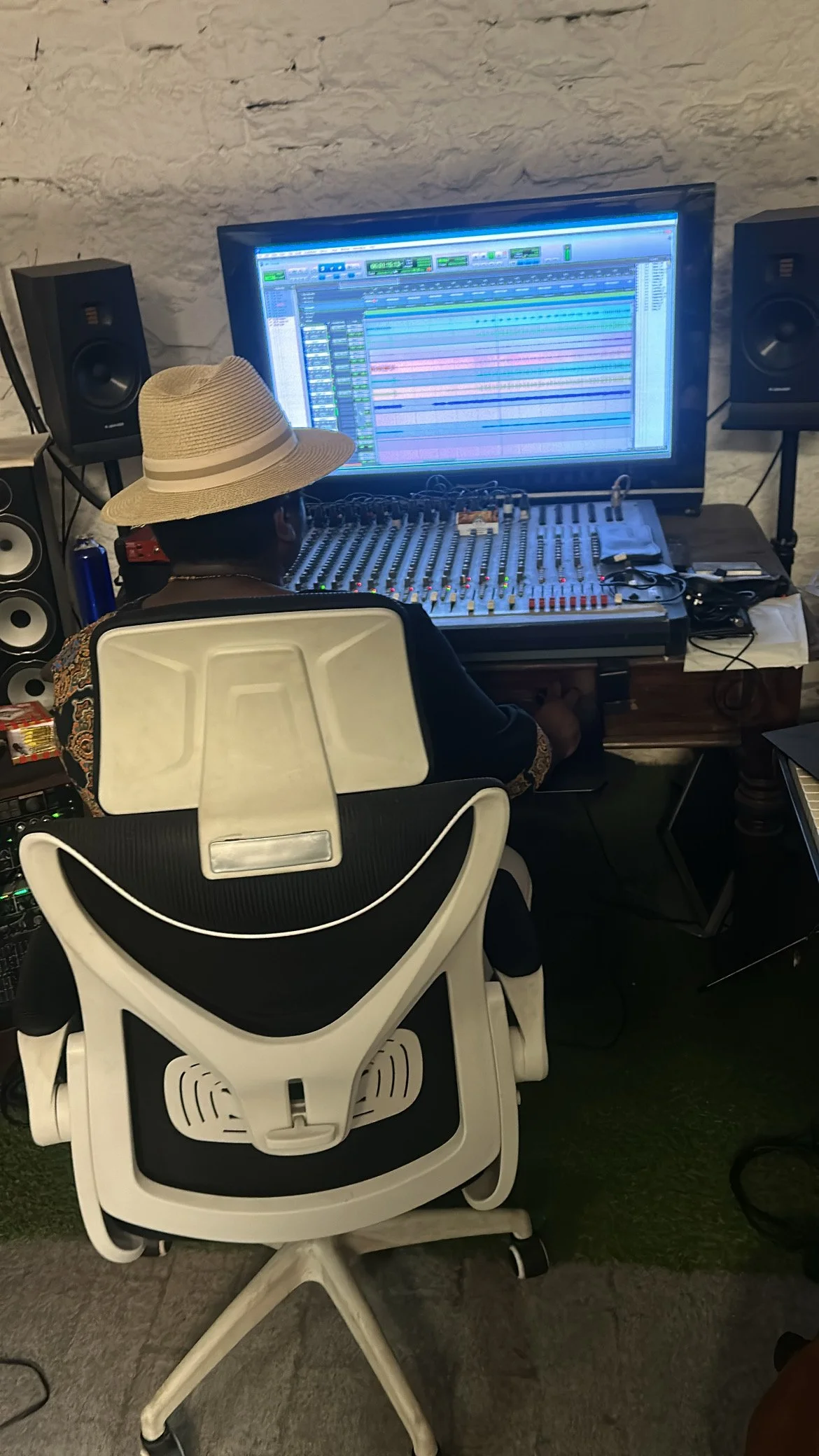
Back In The Studio
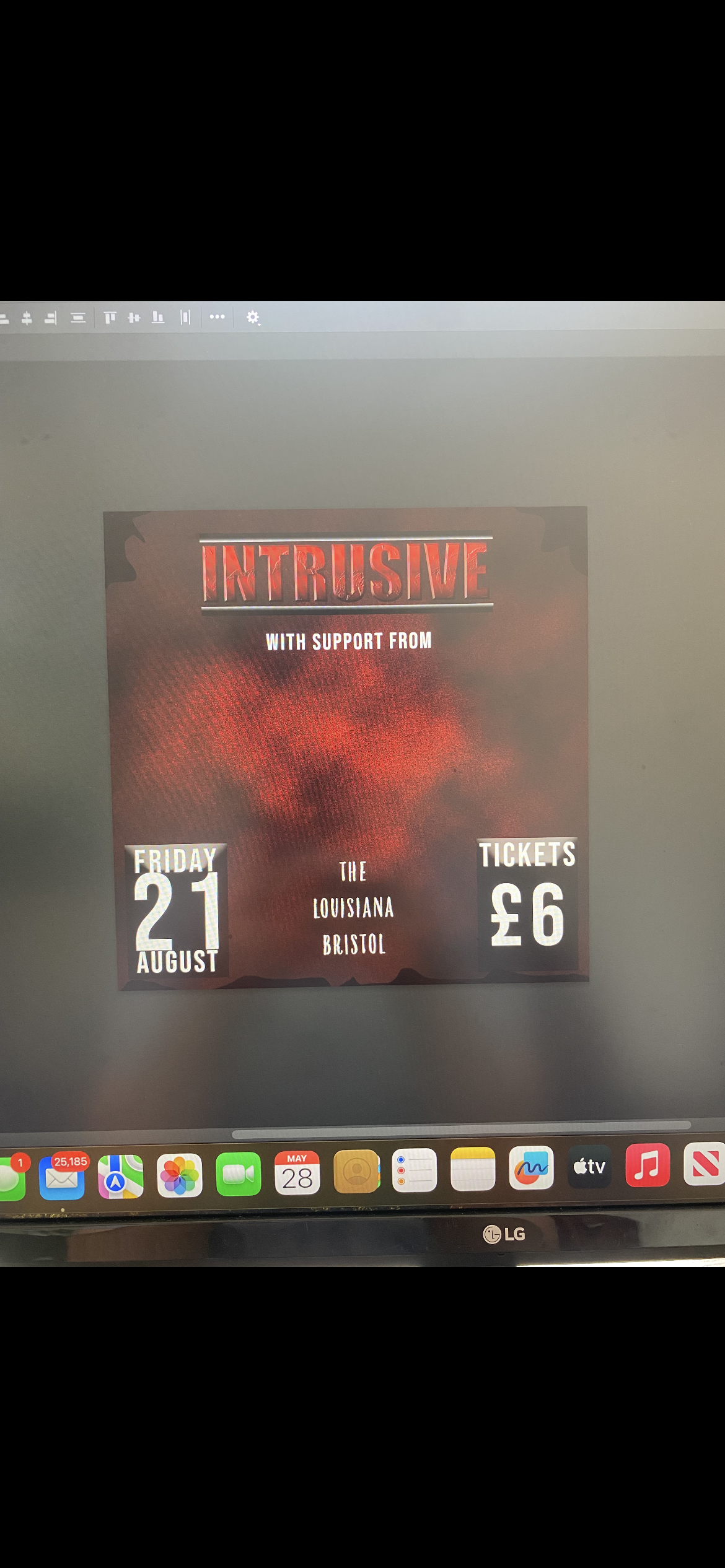
Sam's Early Designs For The Showcase
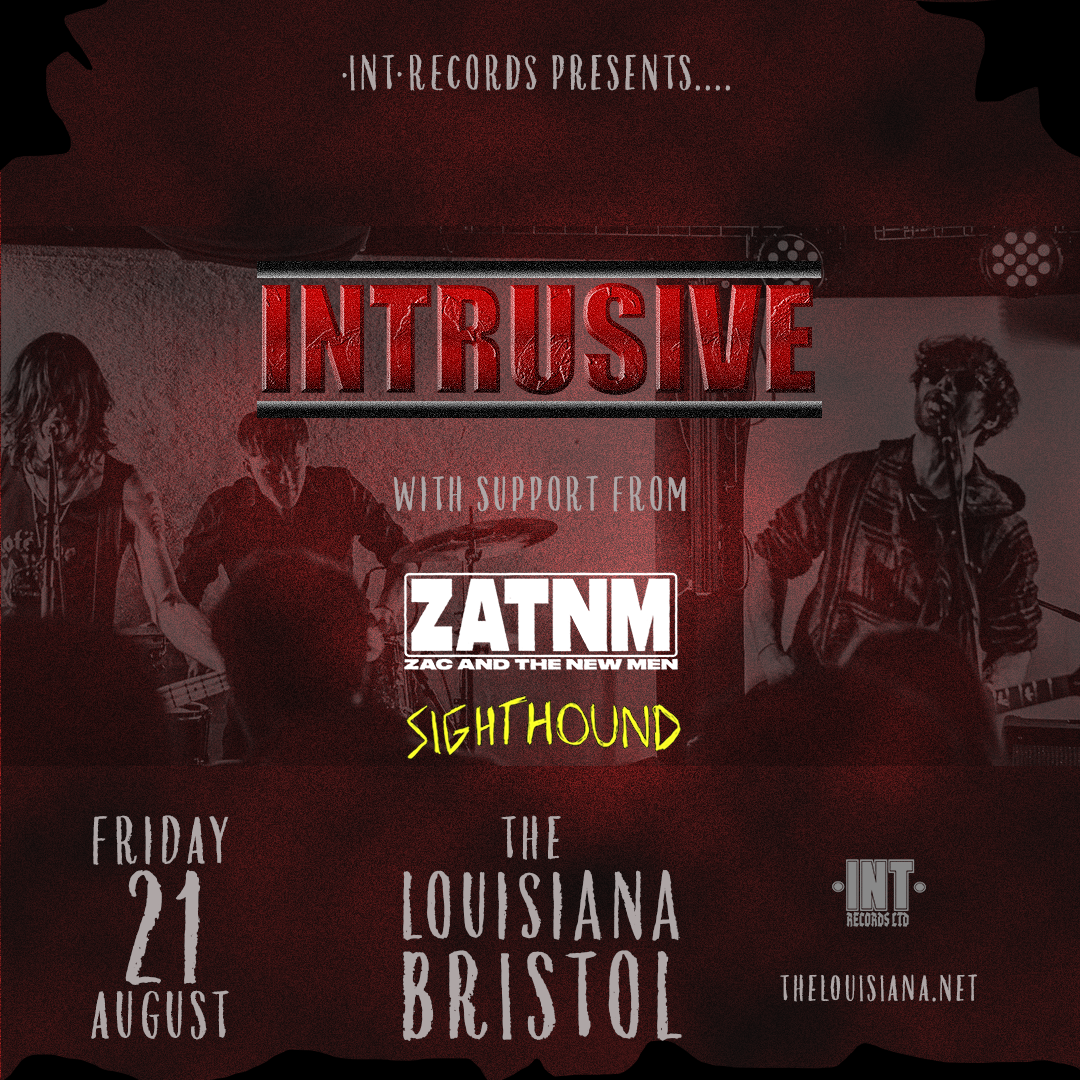
The Final Showcase Poster That Was Used
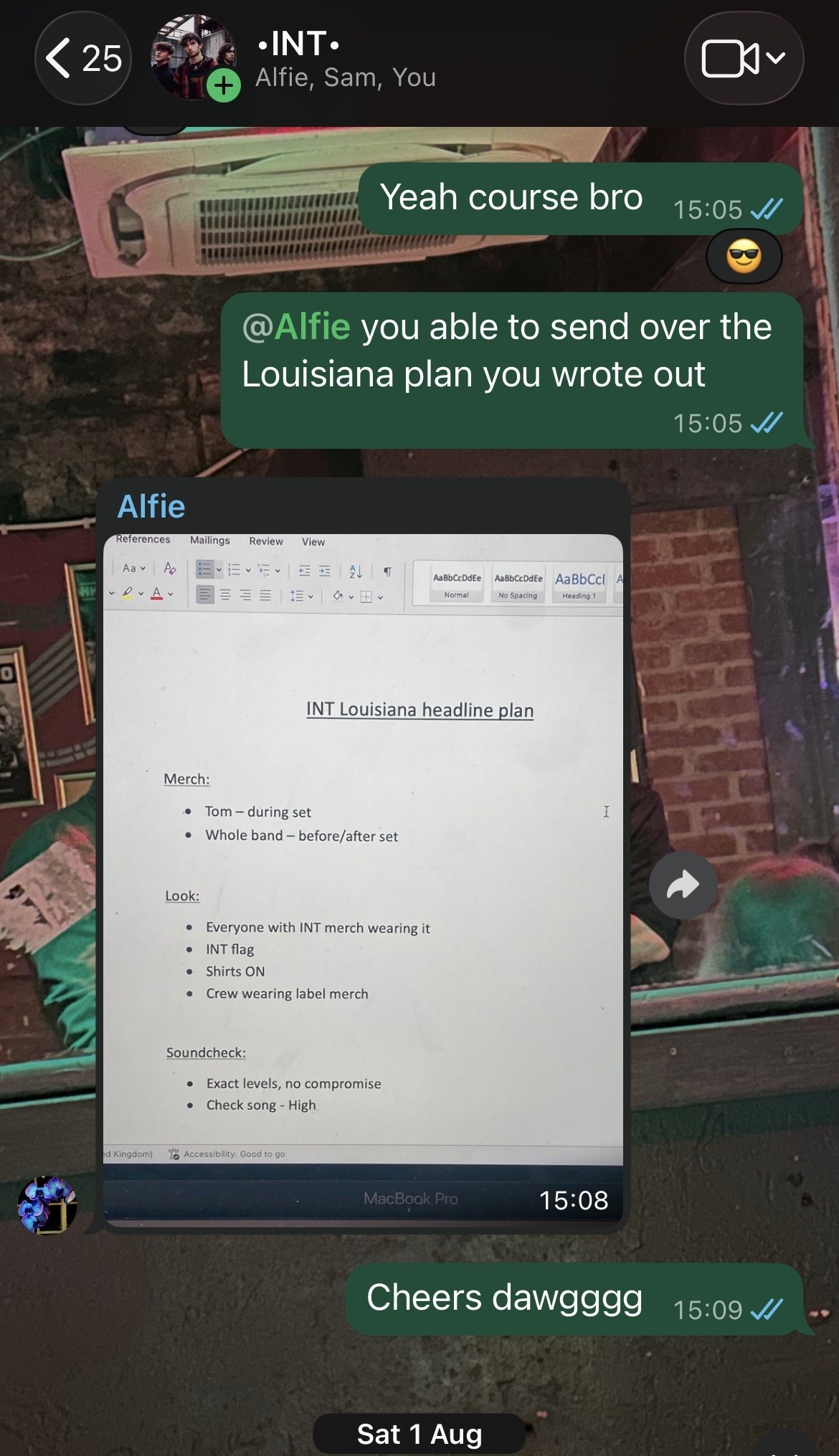
Some Of Our WhatsApp Exchanges After A Productive Meeting
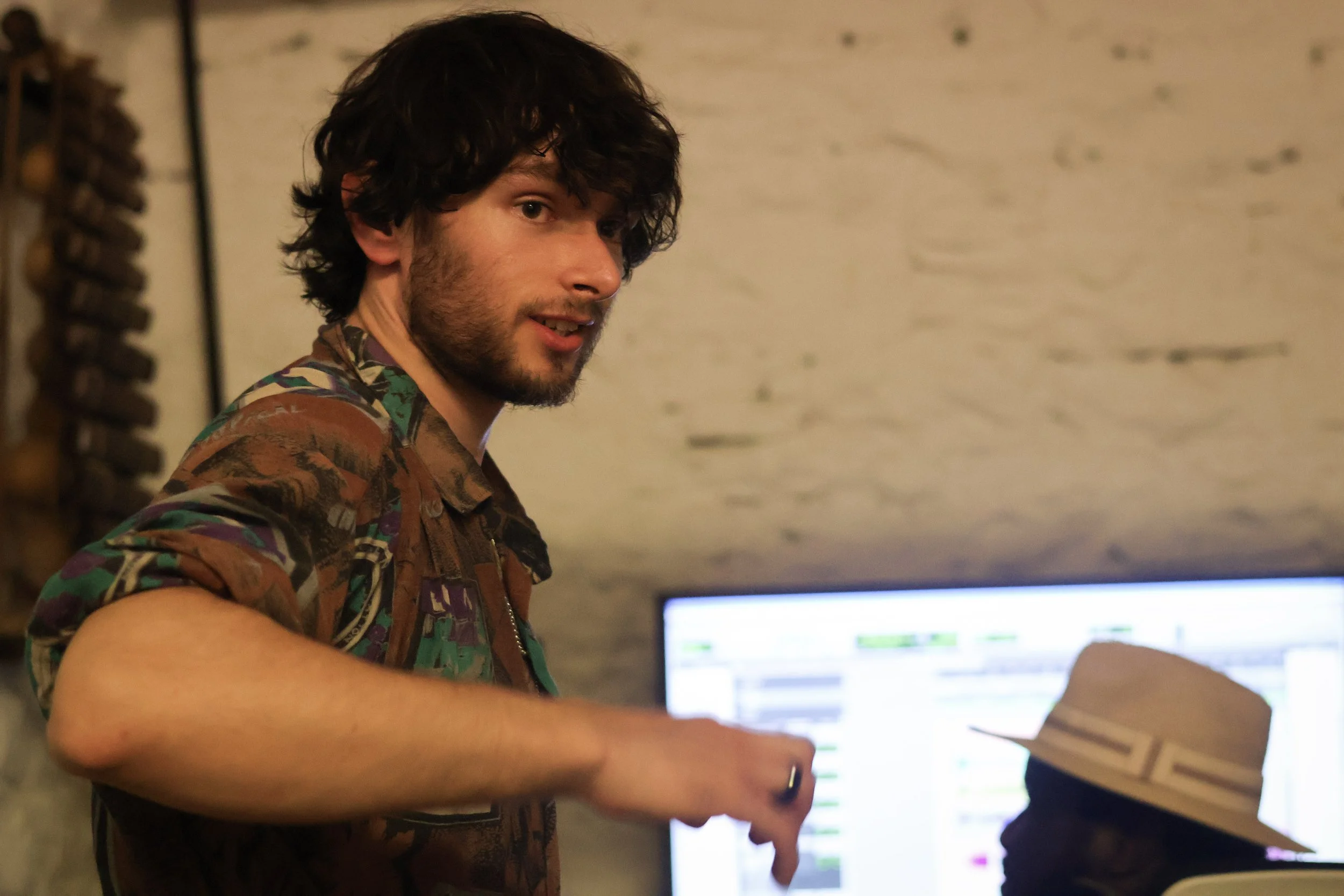
Sam In Session (Alfie Cam)
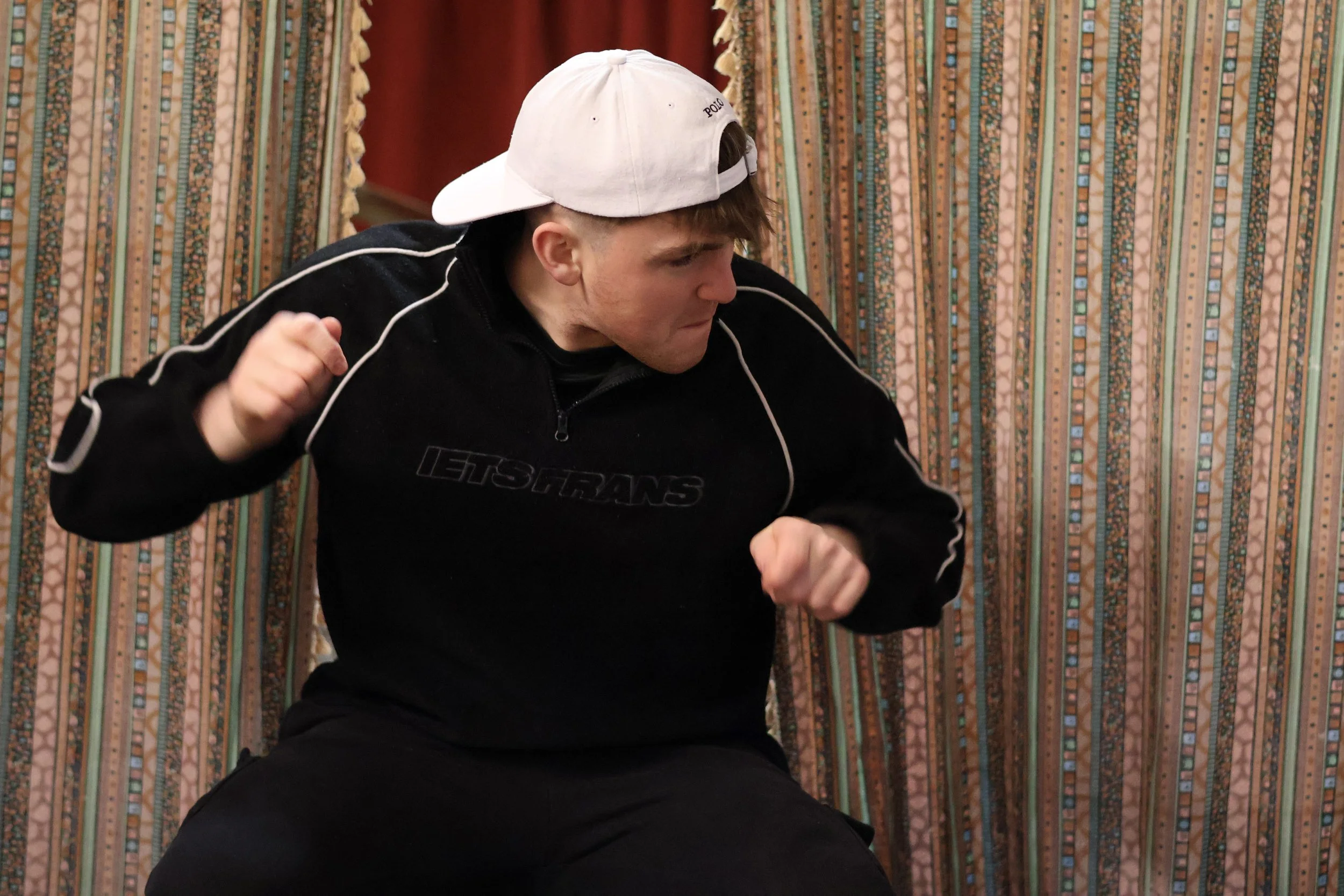
Me Air Drumming To One Of Our Takes (Alfie Cam)
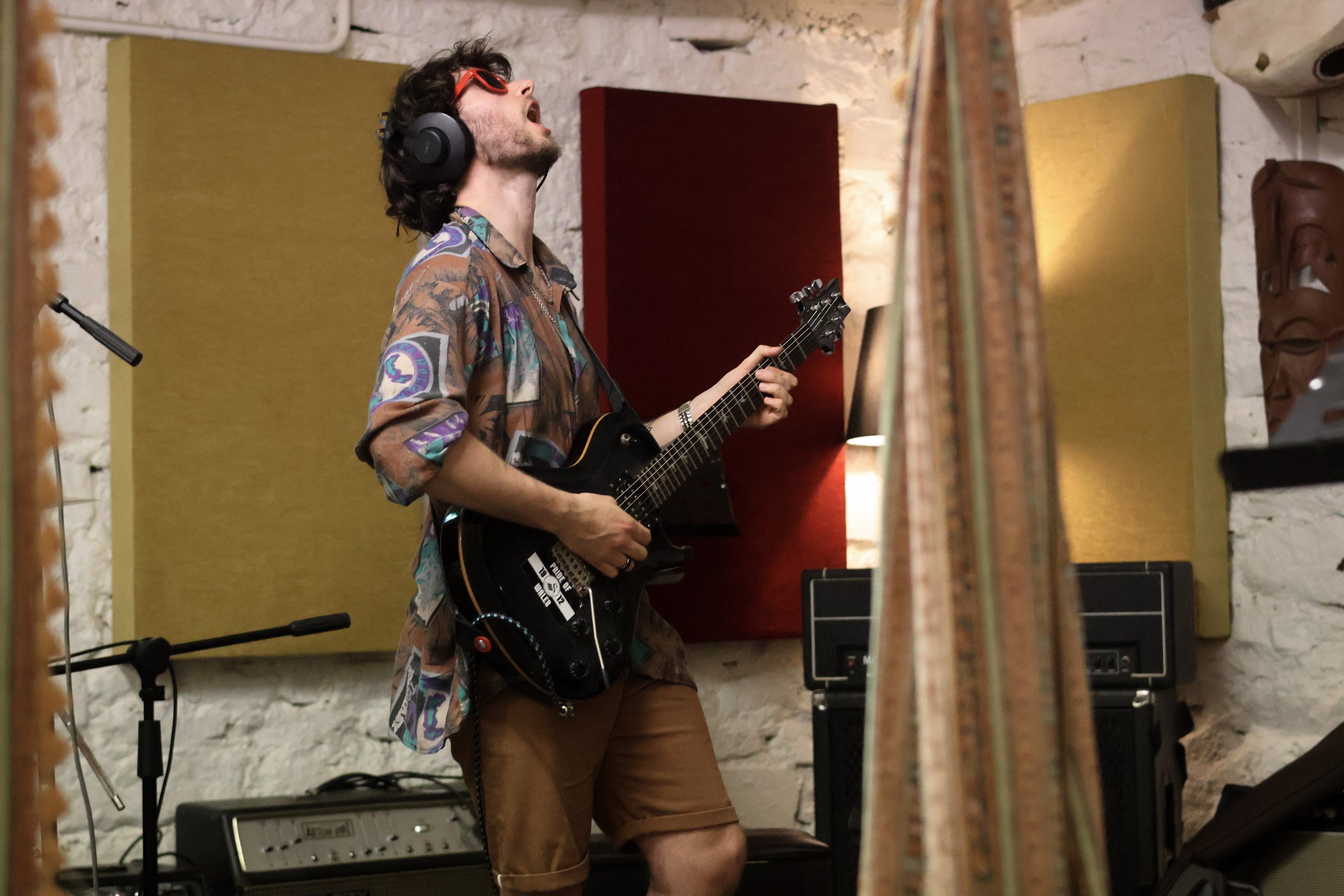
Sam Deep In The Pocket (Alfie Cam)
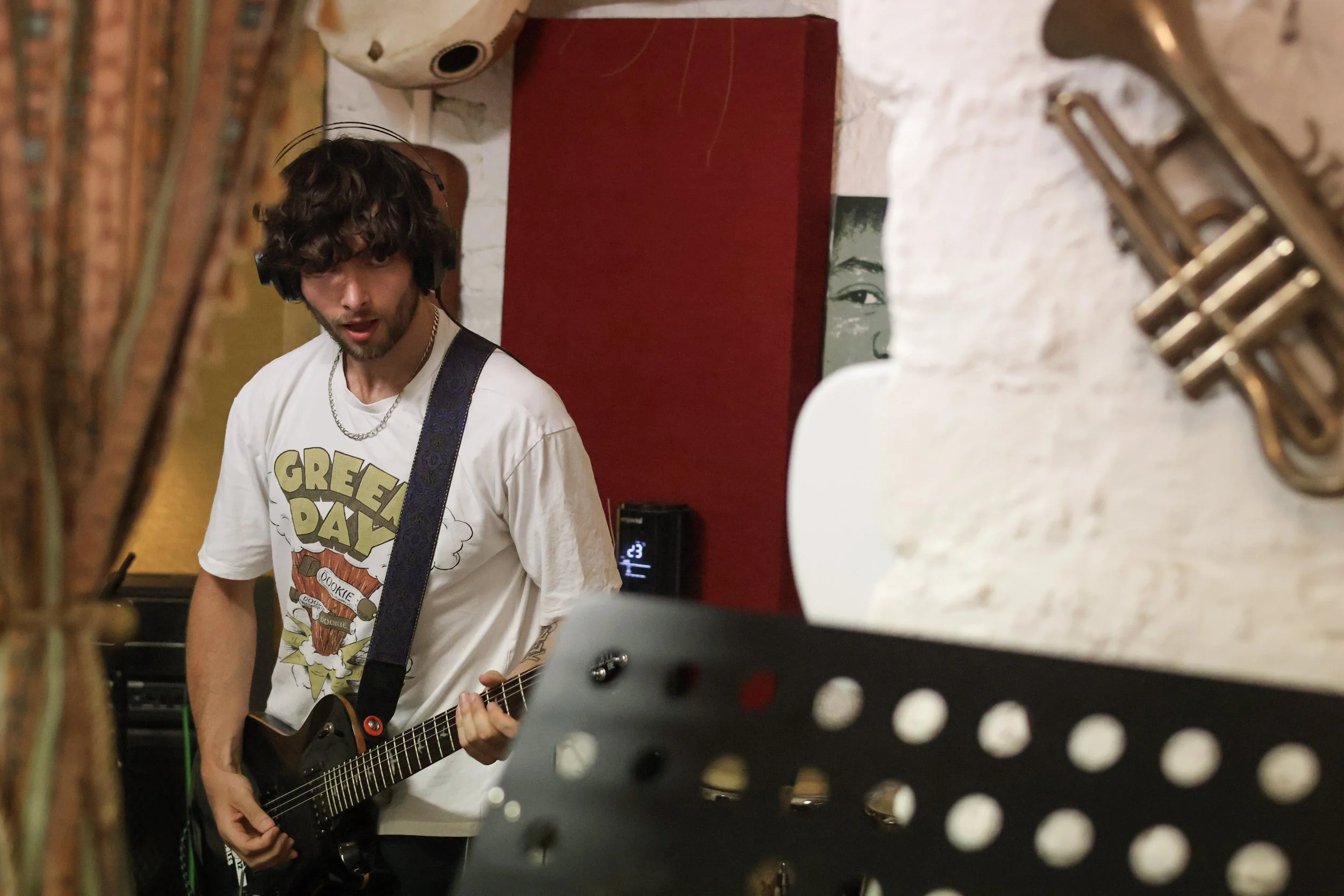
Sam Recording Some Intense Guitar Parts (Alfie Cam)
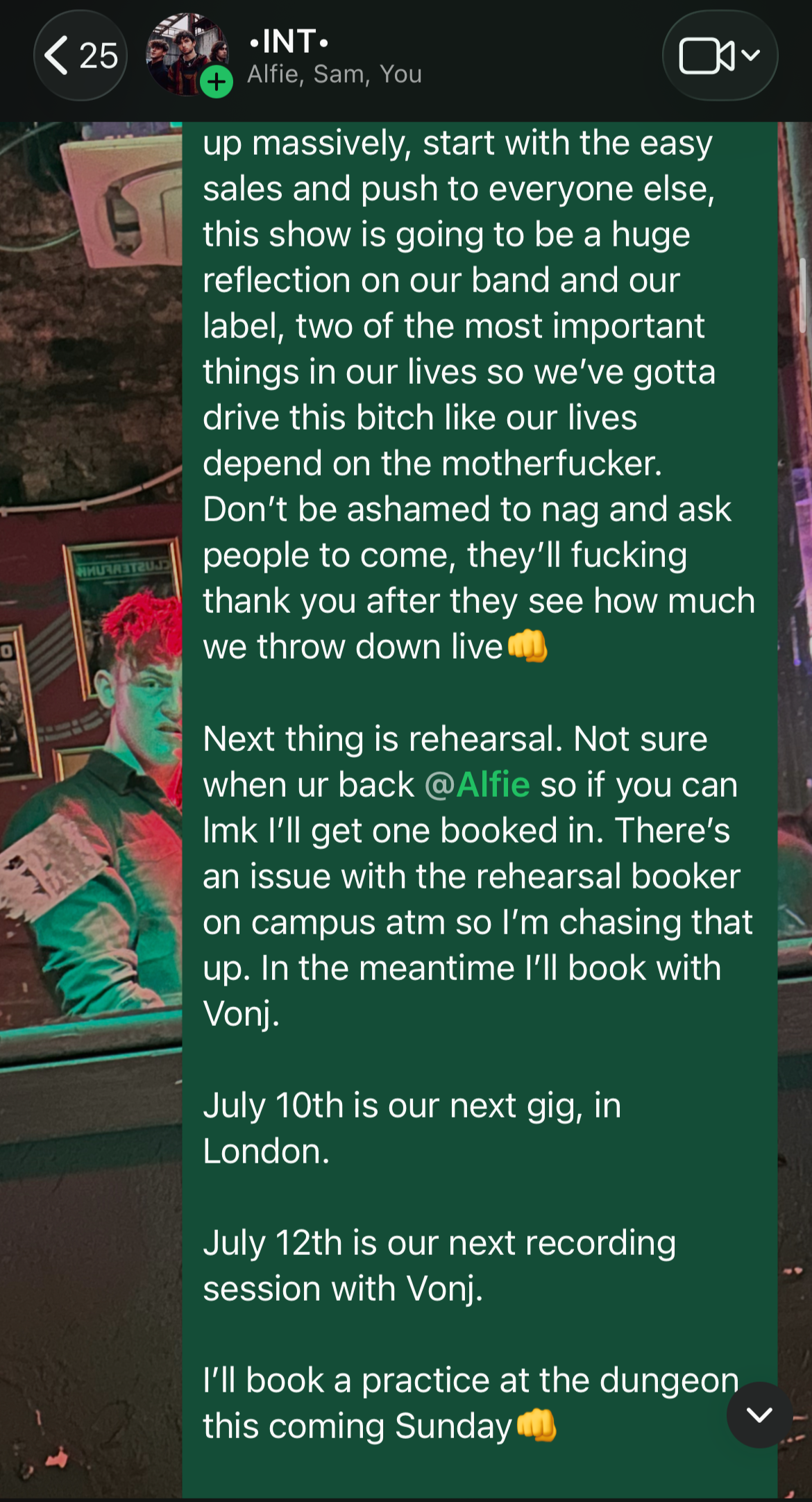
A Message I Sent The Band Whilst We Were On A Small Summer Break
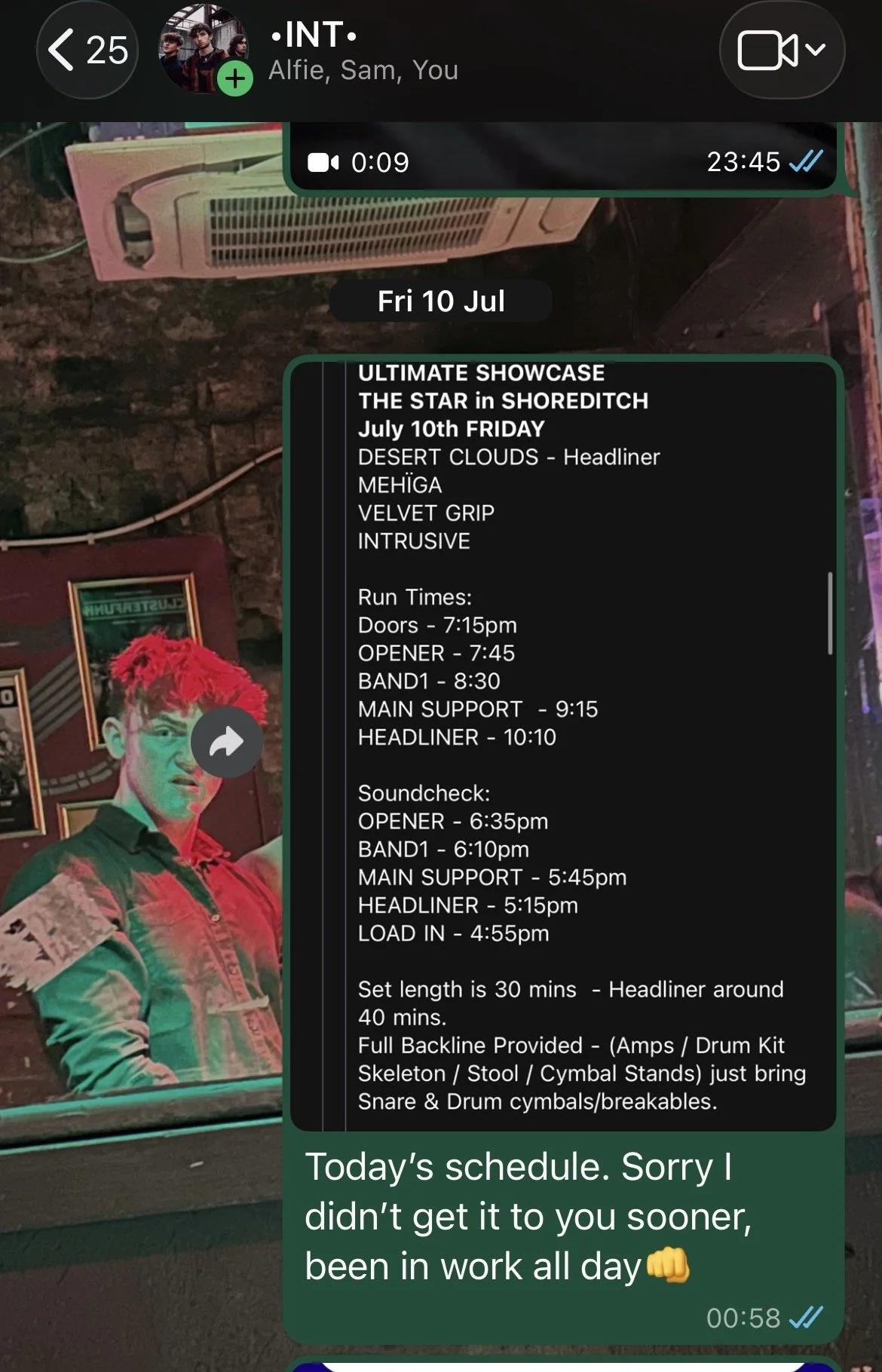
Sorting Schedules For Our London Show In July
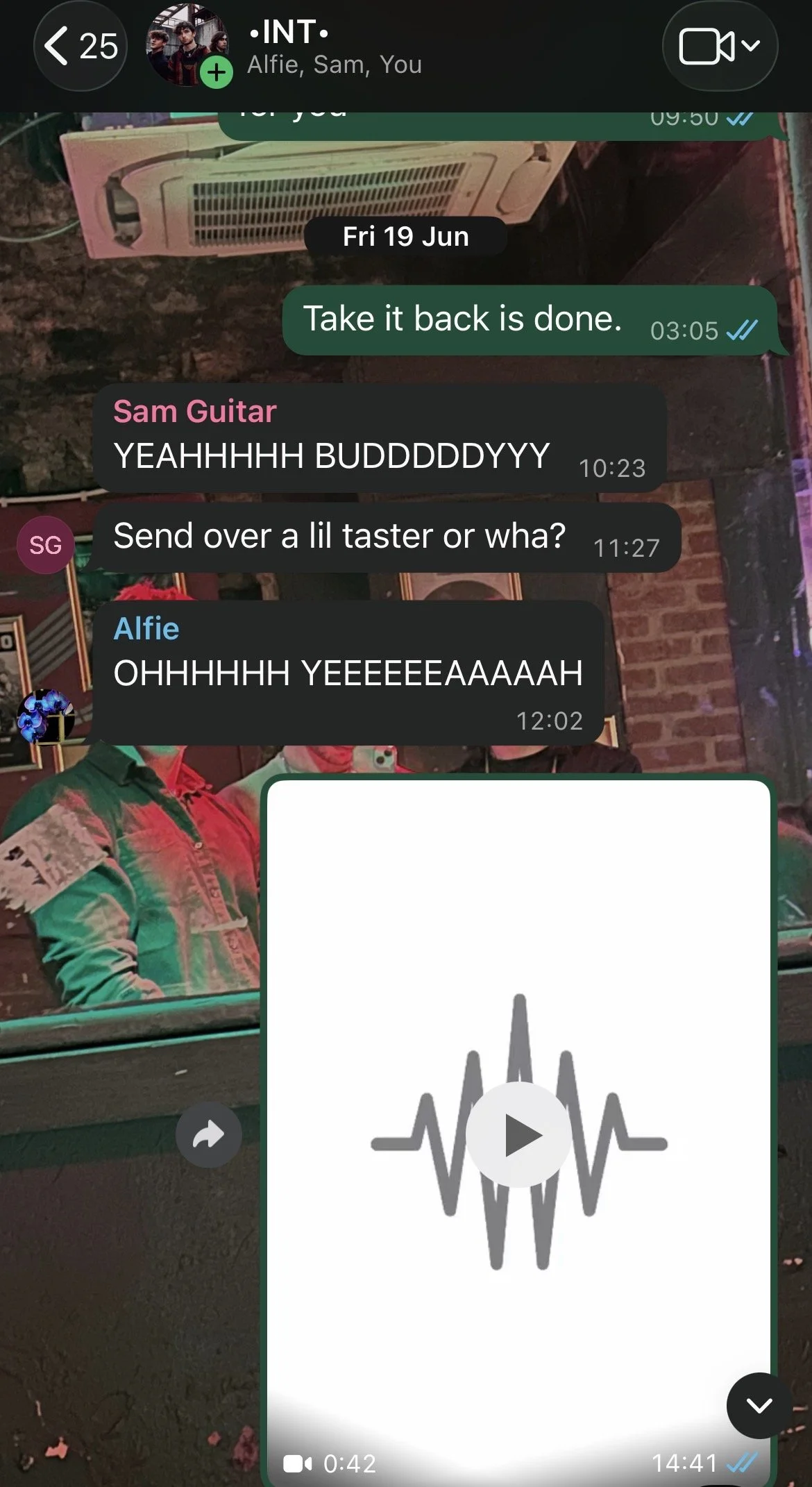
During The Summer Break I'd Finished Mixing And Mastering "Take It Back"
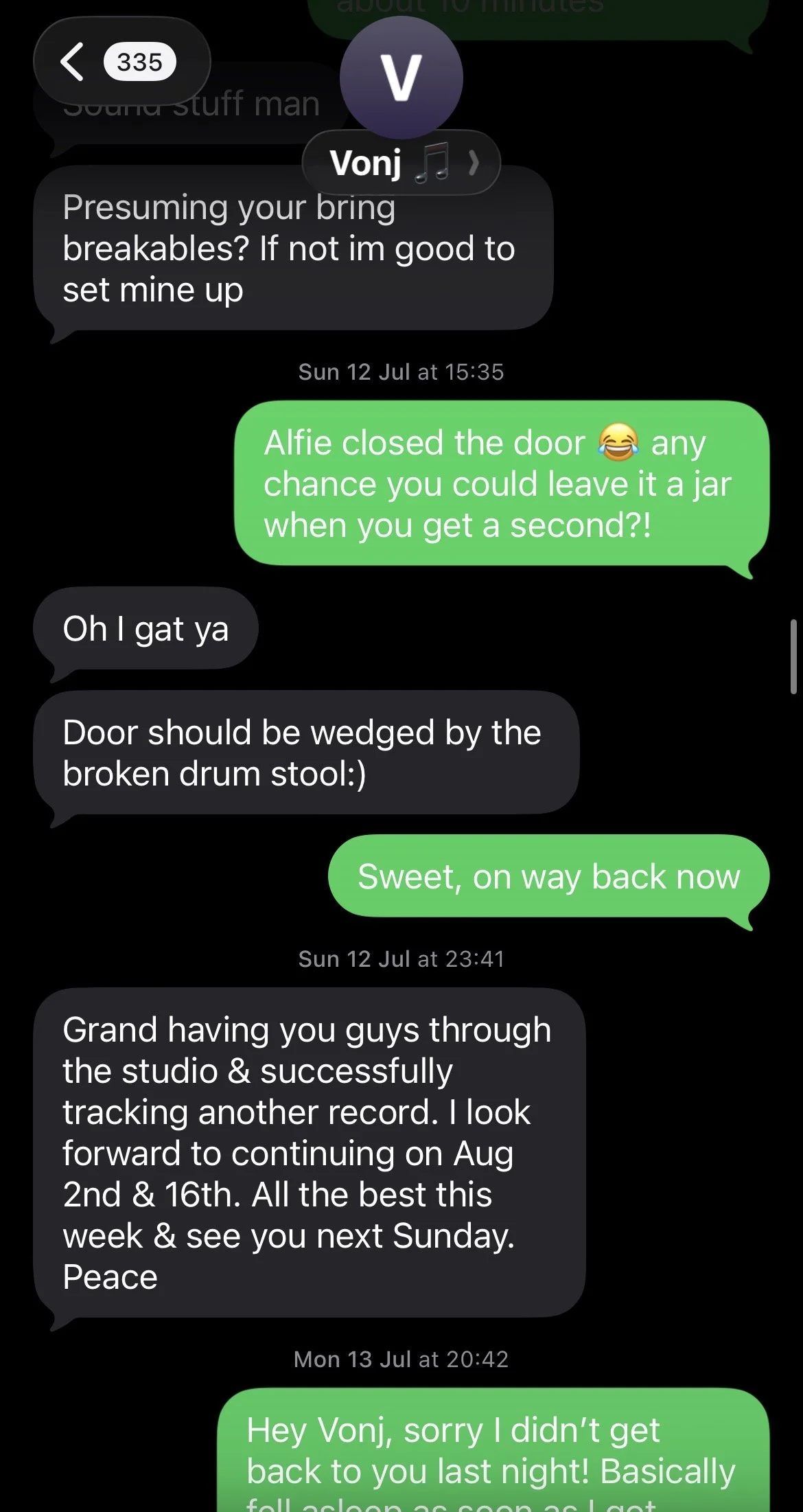
Myself And Vonj Staying Up To Date And Organising The Recording Process
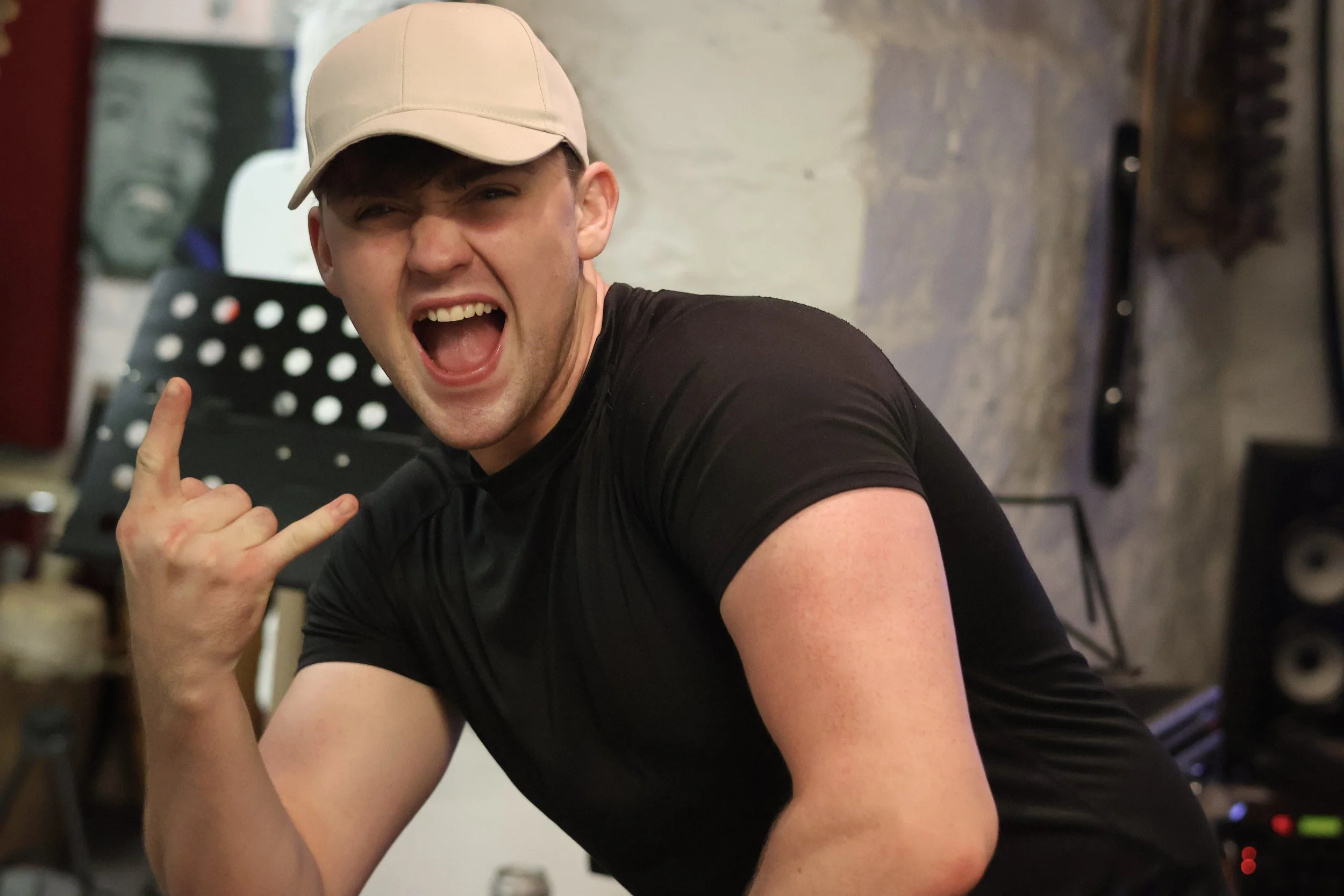
Me Being Very Thrilled With A Take (Alfie Cam)
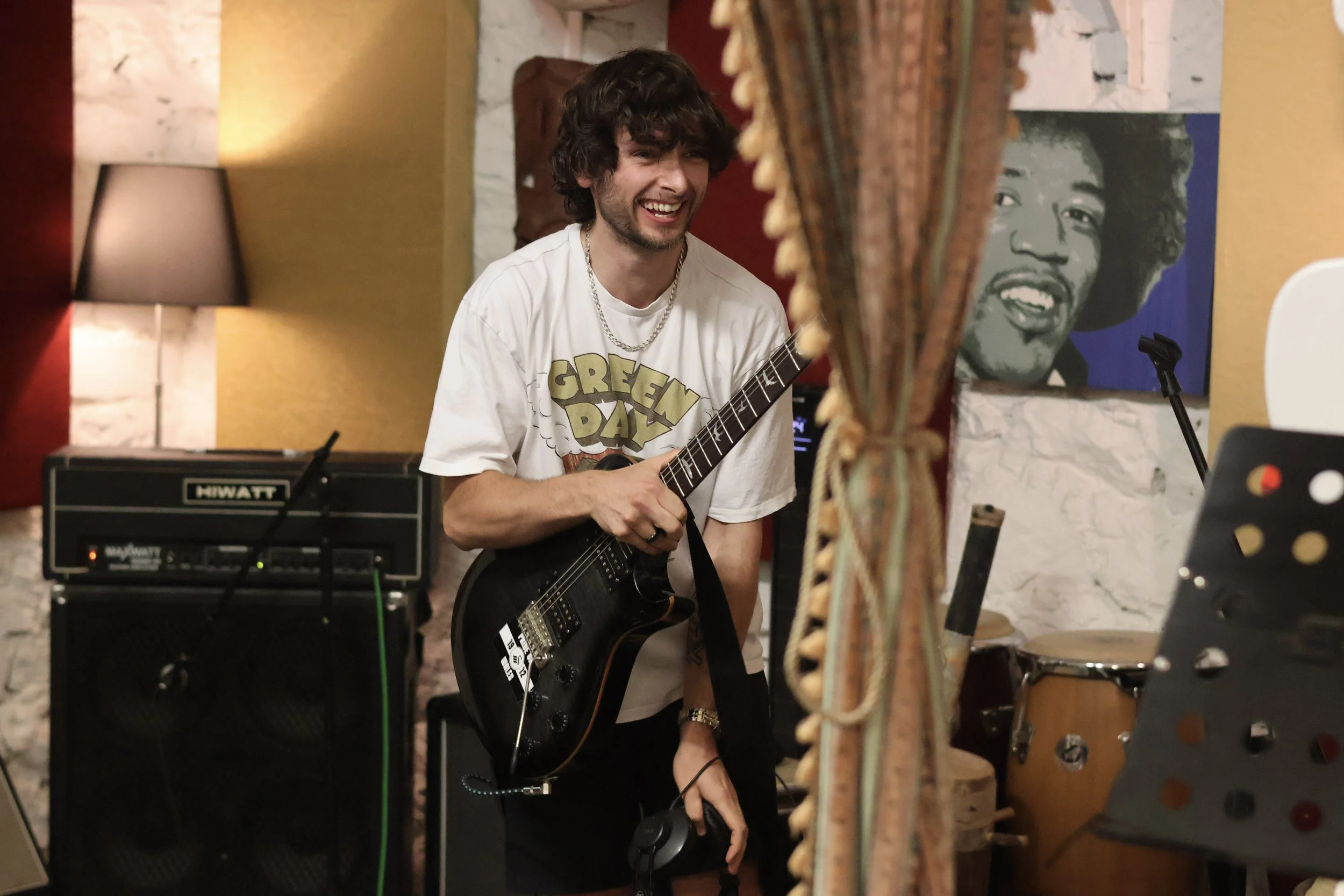
Sam Also Being Very Thrilled By A Take... And Somewhat Relieved By The Looks Of Things (Alfie Cam)
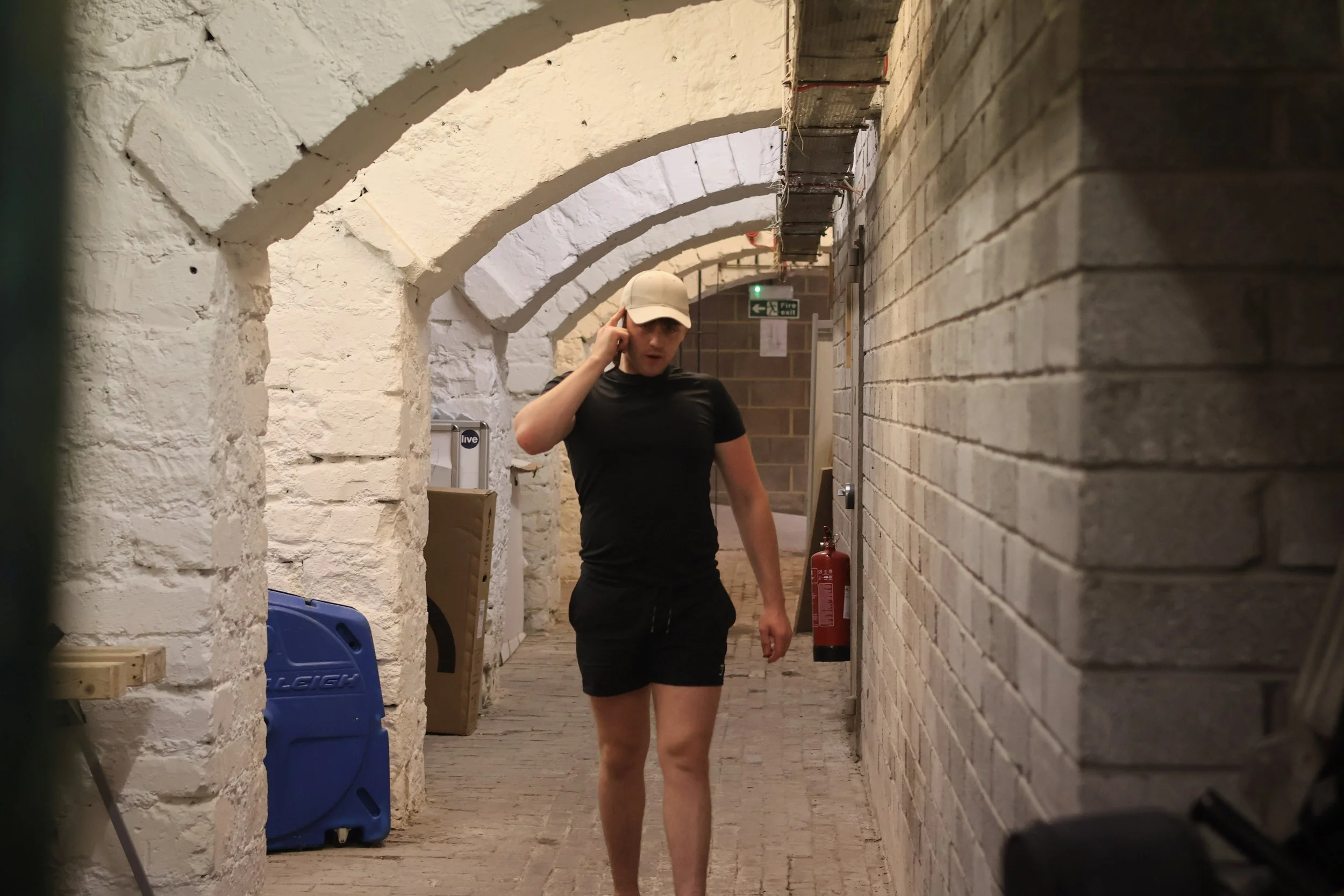
Taking A Phone Call Regarding Our Showcase Whilst In The Studio (Alfie Cam)
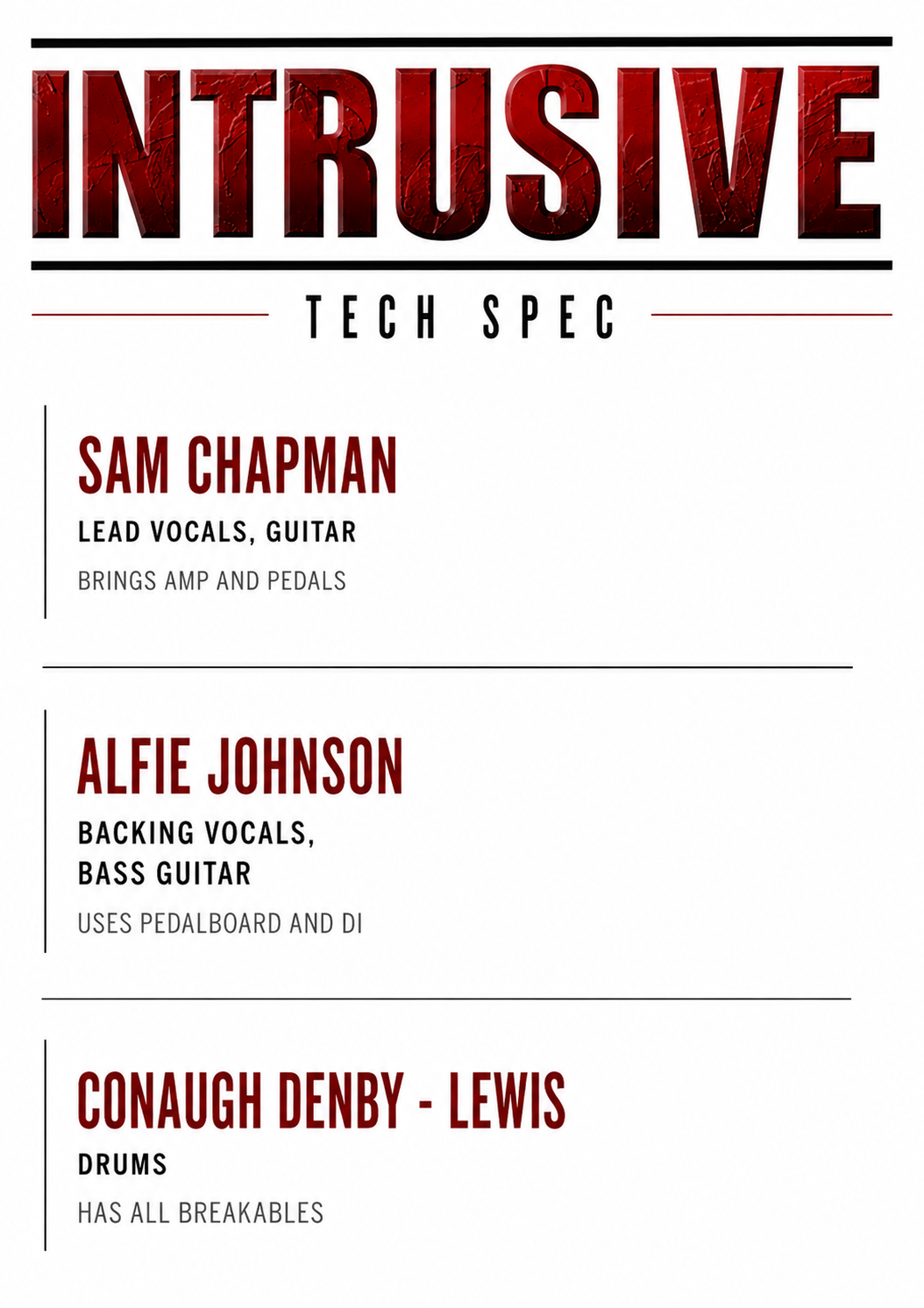
Preparing Our Tech Specs For The louisiana
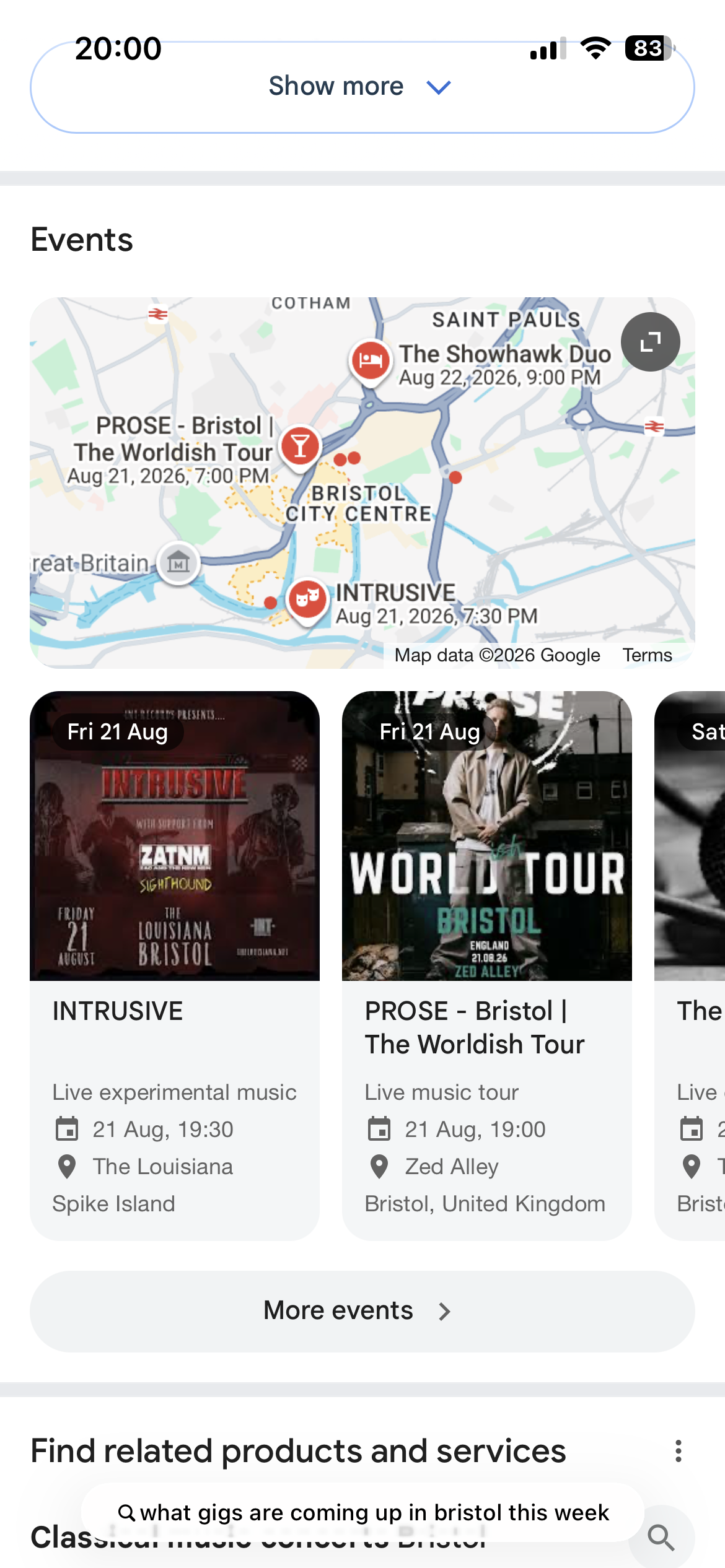
A Public Gig Listing Under "Gigs In Bristol This Week"
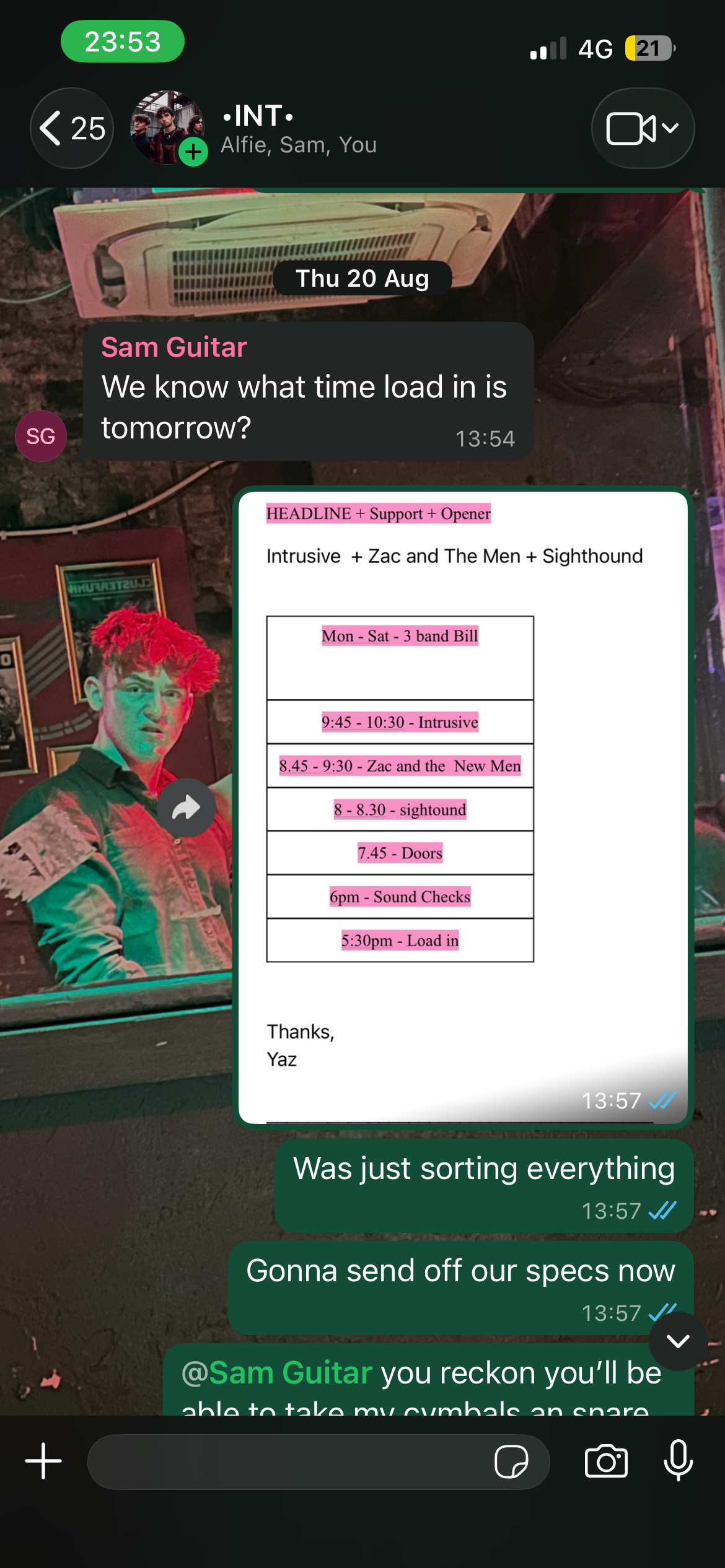
Checking In With The Band
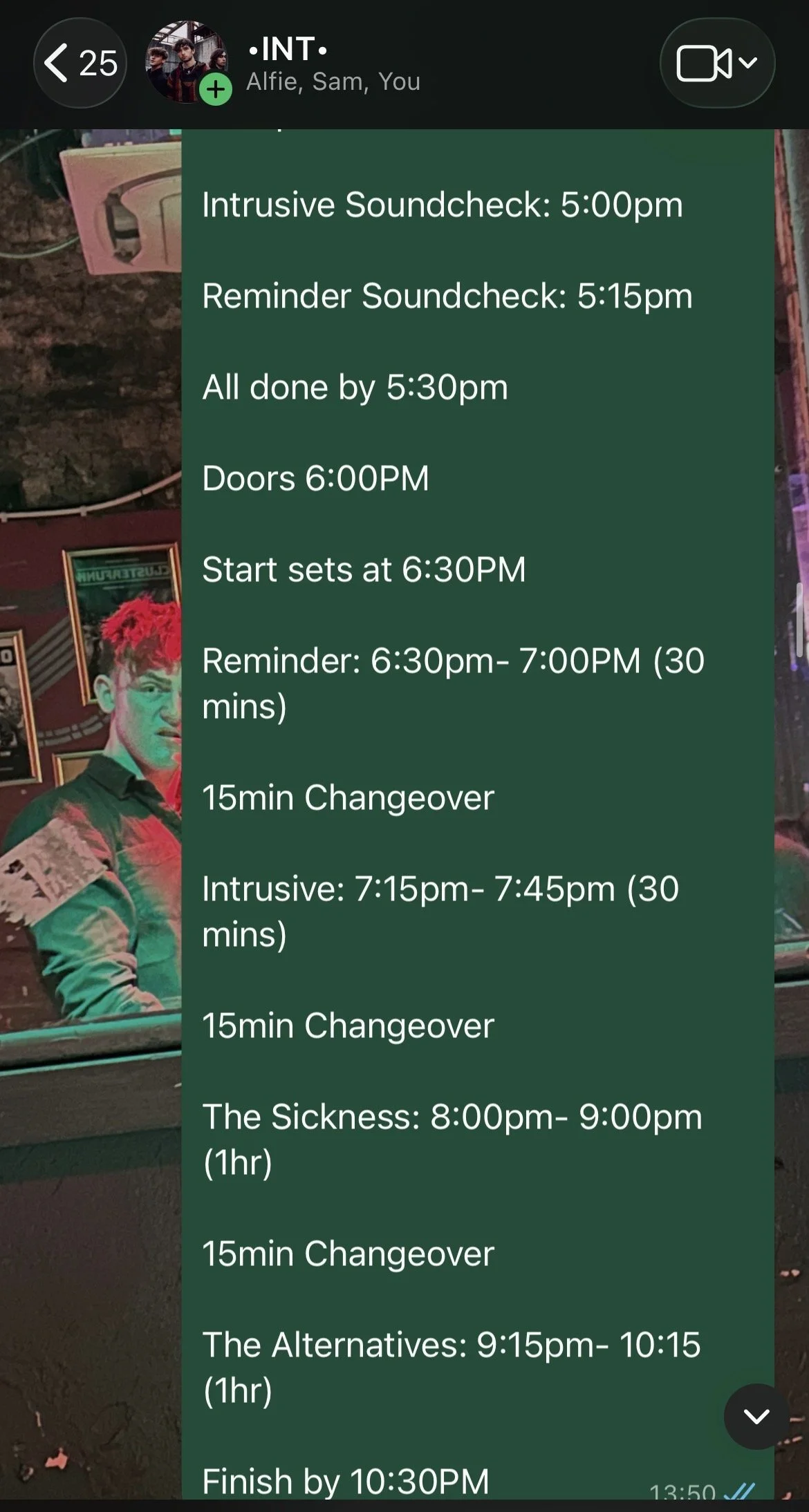
The Schedule For Our Gig In Leicester On The 23rd
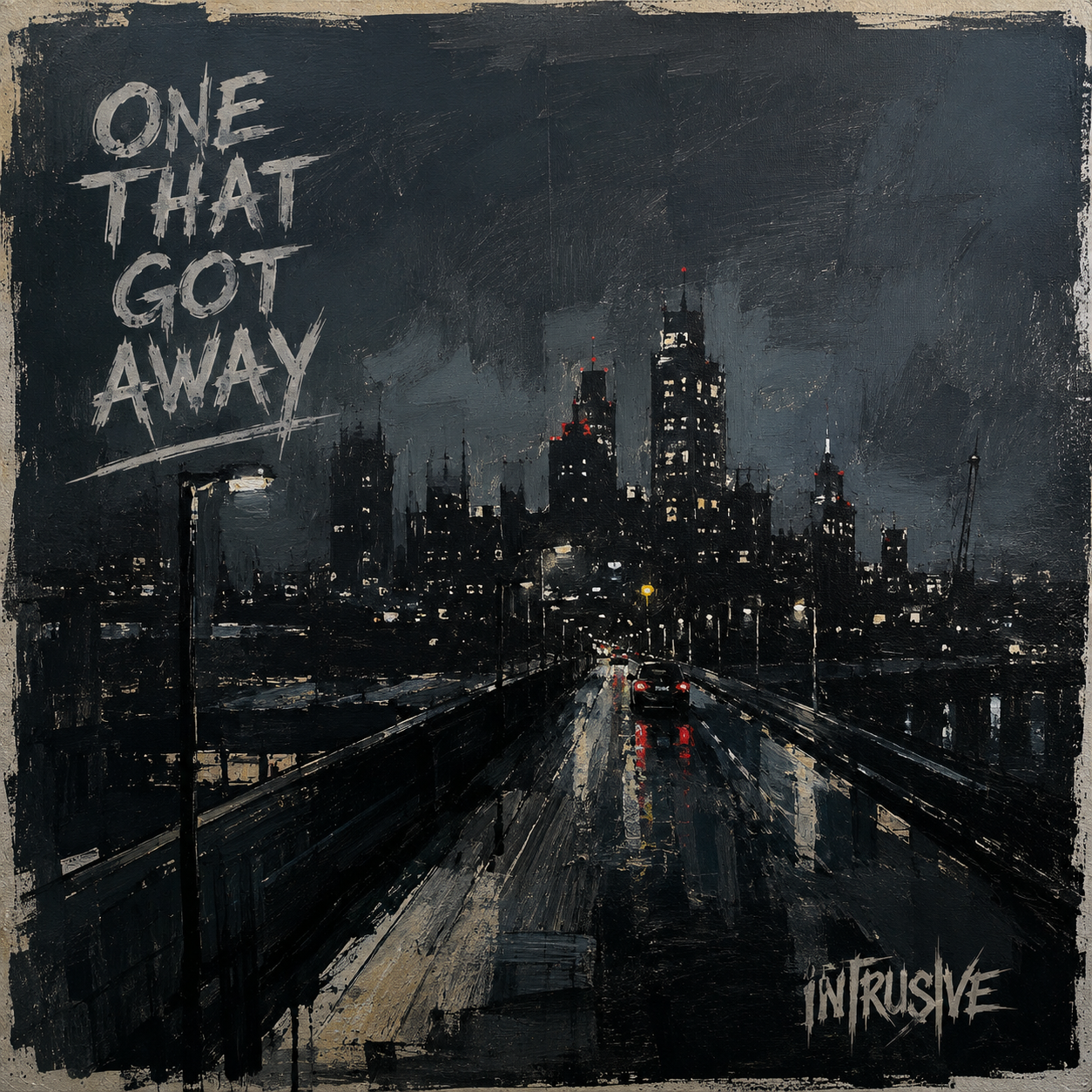
One Of My Choices For The Album Cover
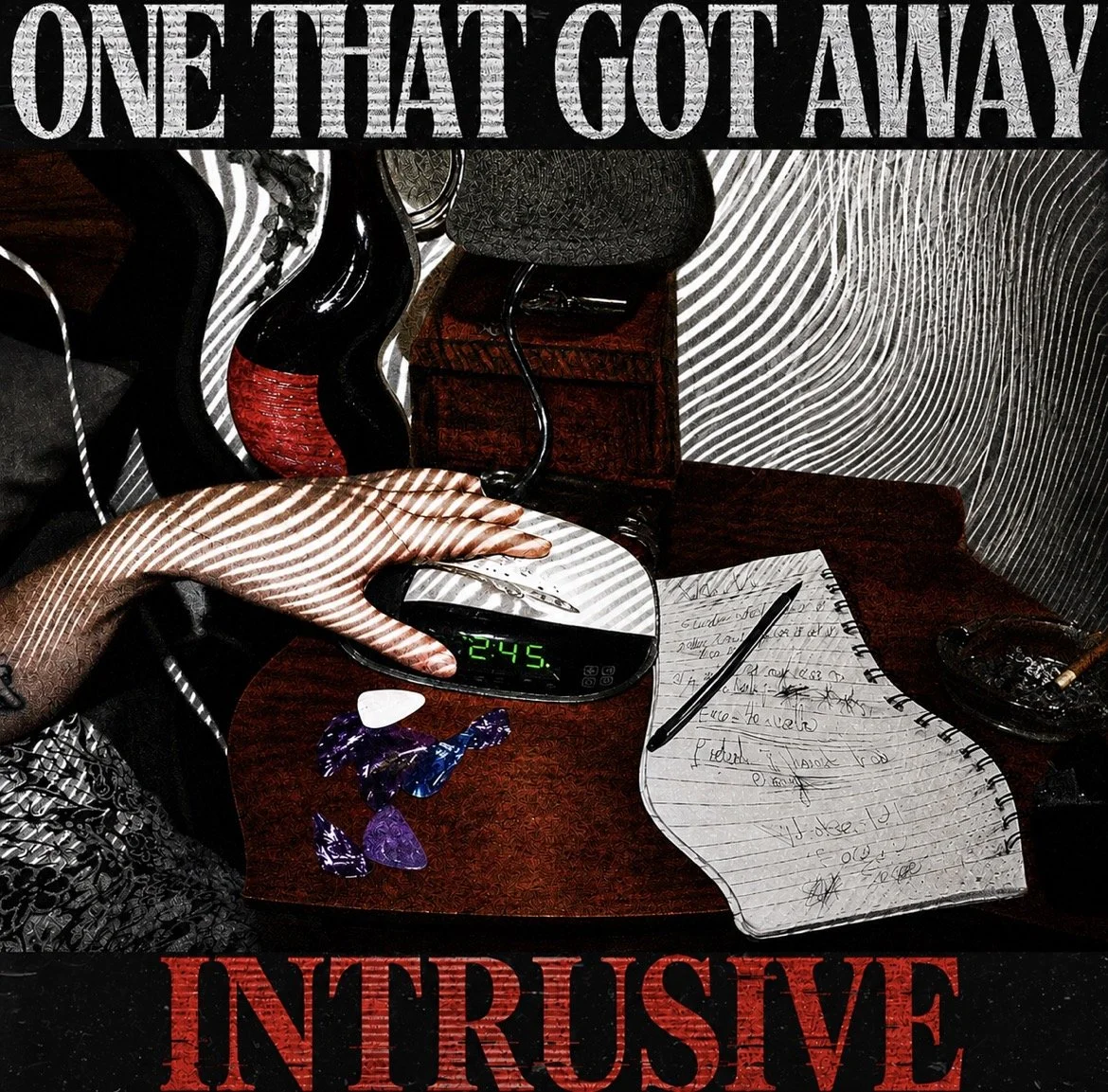
Sam's Final Design For The Album Cover And The One We All Settled On
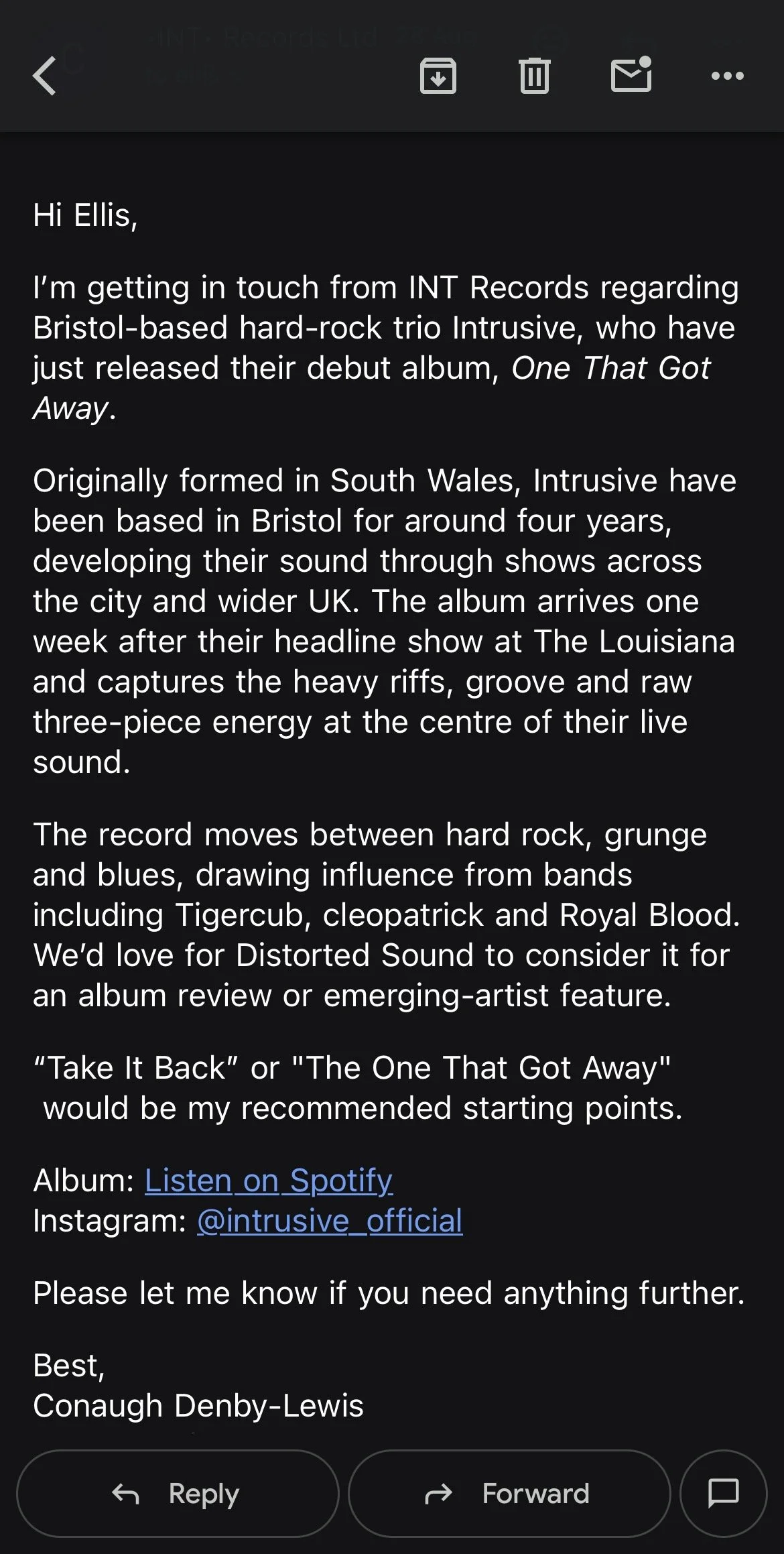
Some Of The Current Emails Being Sent To Radio And Magazine To Feature And Push The Album Right Now (1)
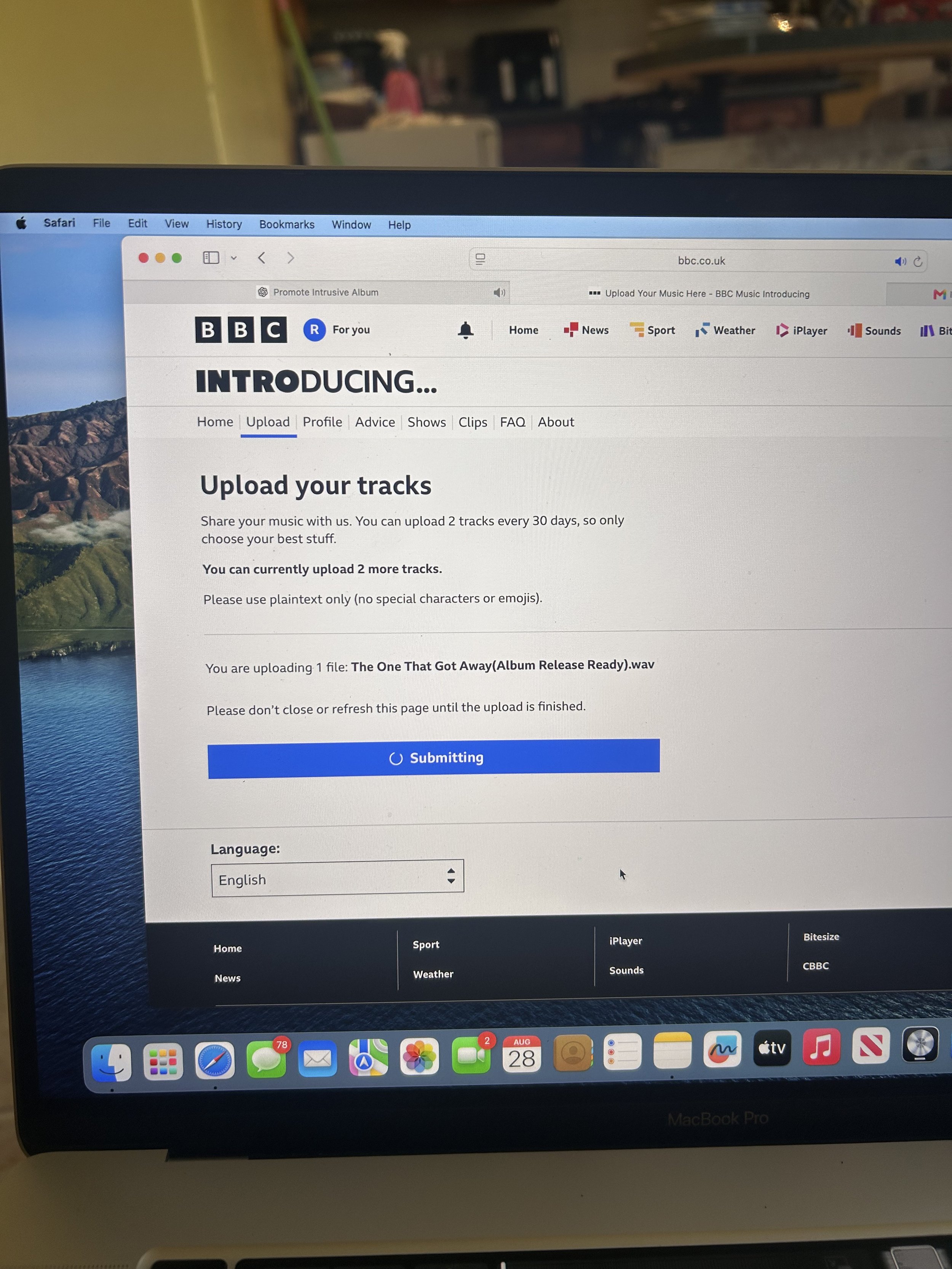
Some Of The Current Emails Being Sent To Radio And Magazine To Feature And Push The Album Right Now (2)
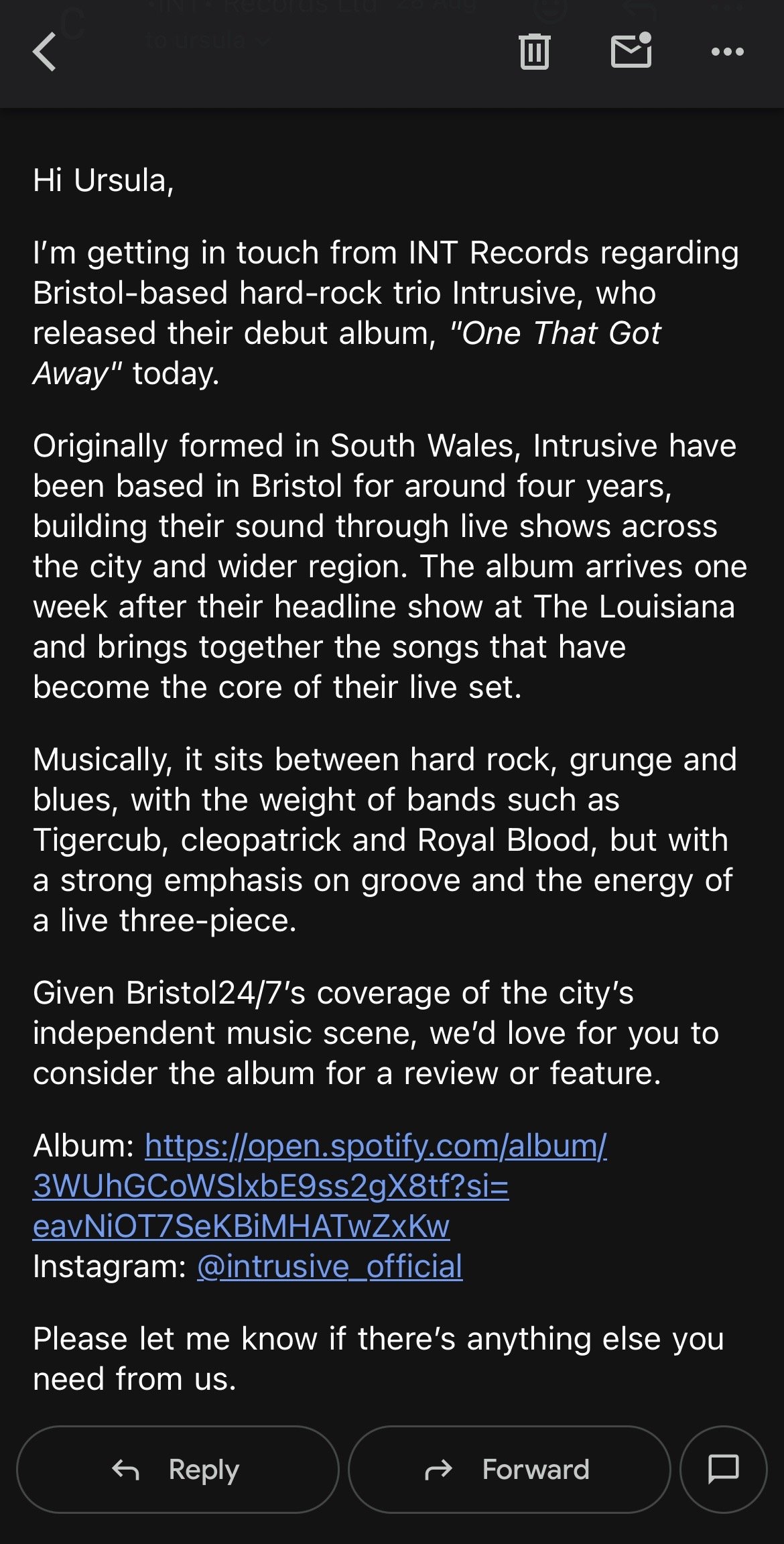
Some Of The Current Emails Being Sent To Radio And Magazine To Feature And Push The Album Right Now (3)
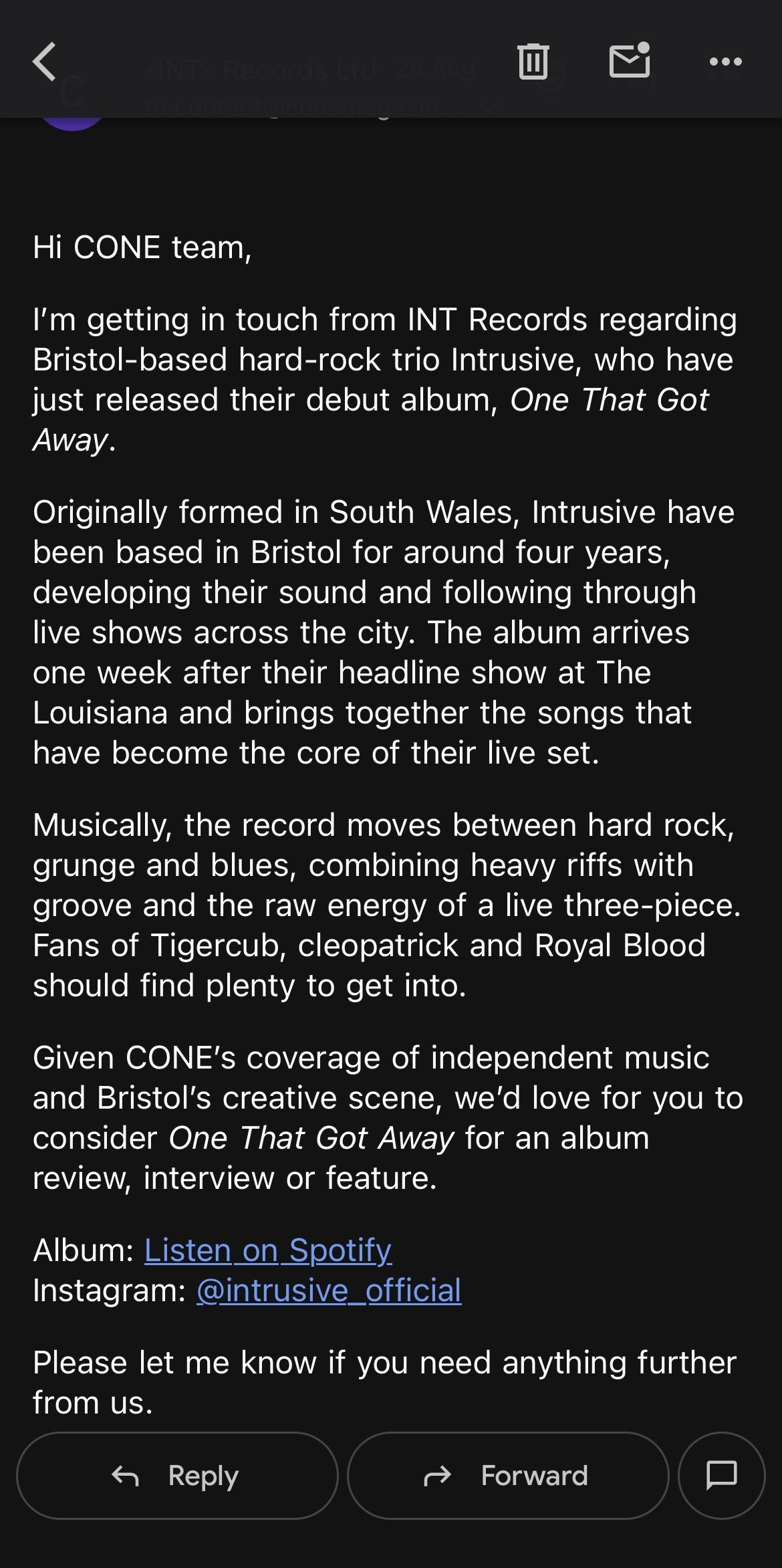
Some Of The Current Emails Being Sent To Radio And Magazine To Feature And Push The Album Right Now (4)
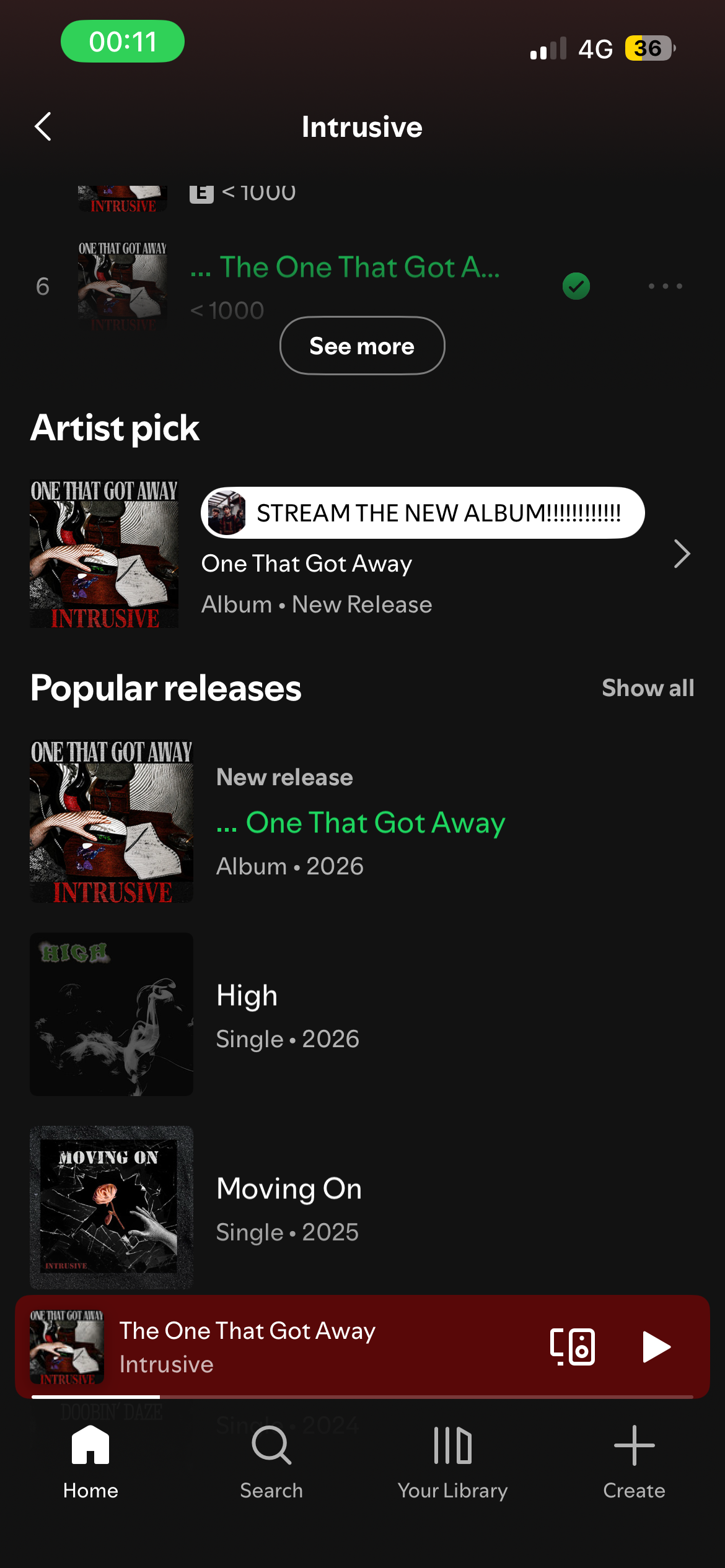
Our Album Live And Ready To Stream
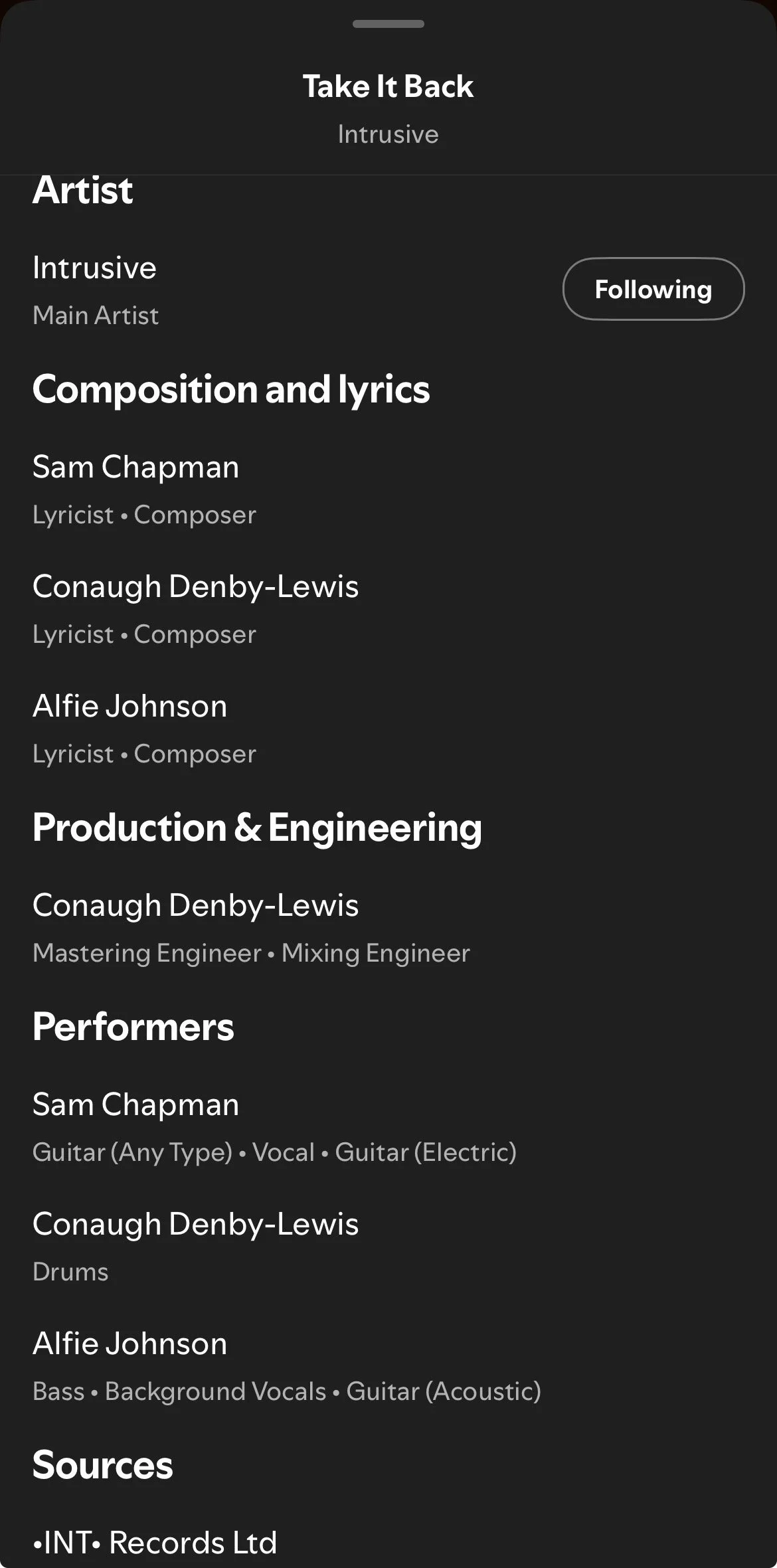
Label, Production And Performance Credits
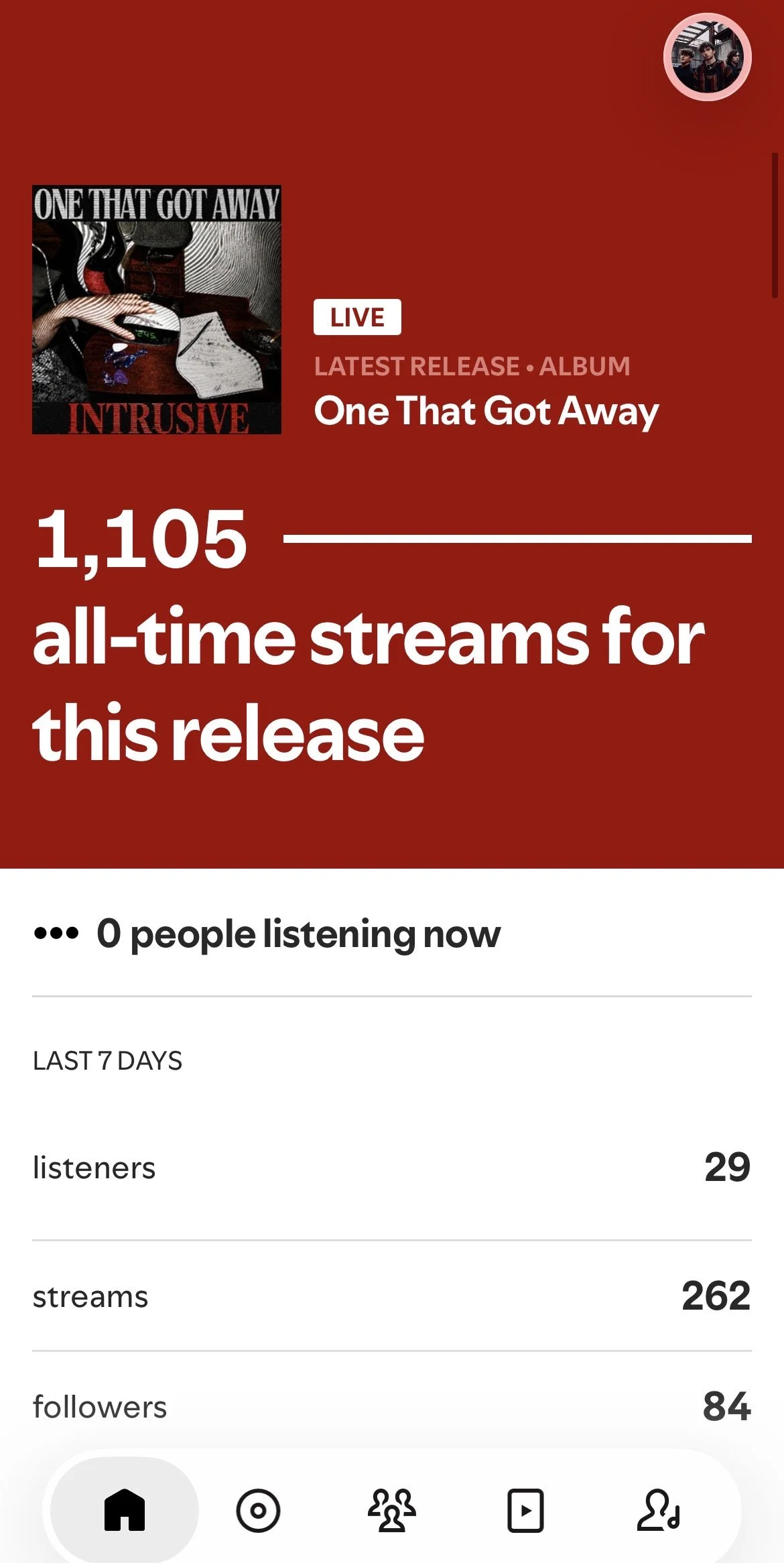
The Albums Streaming Stats One Day After Release On The 29th Of August
Studio Snippets
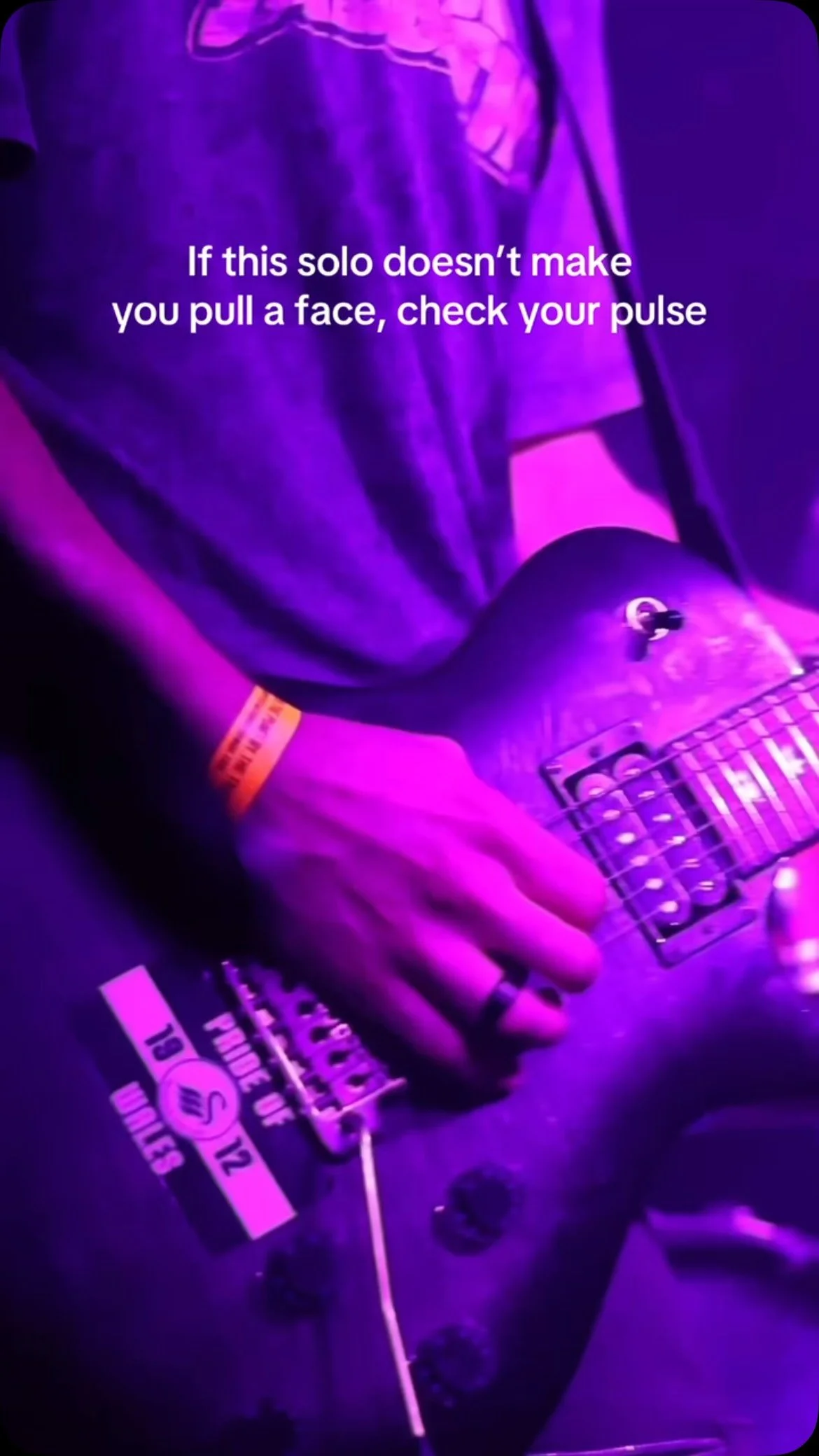
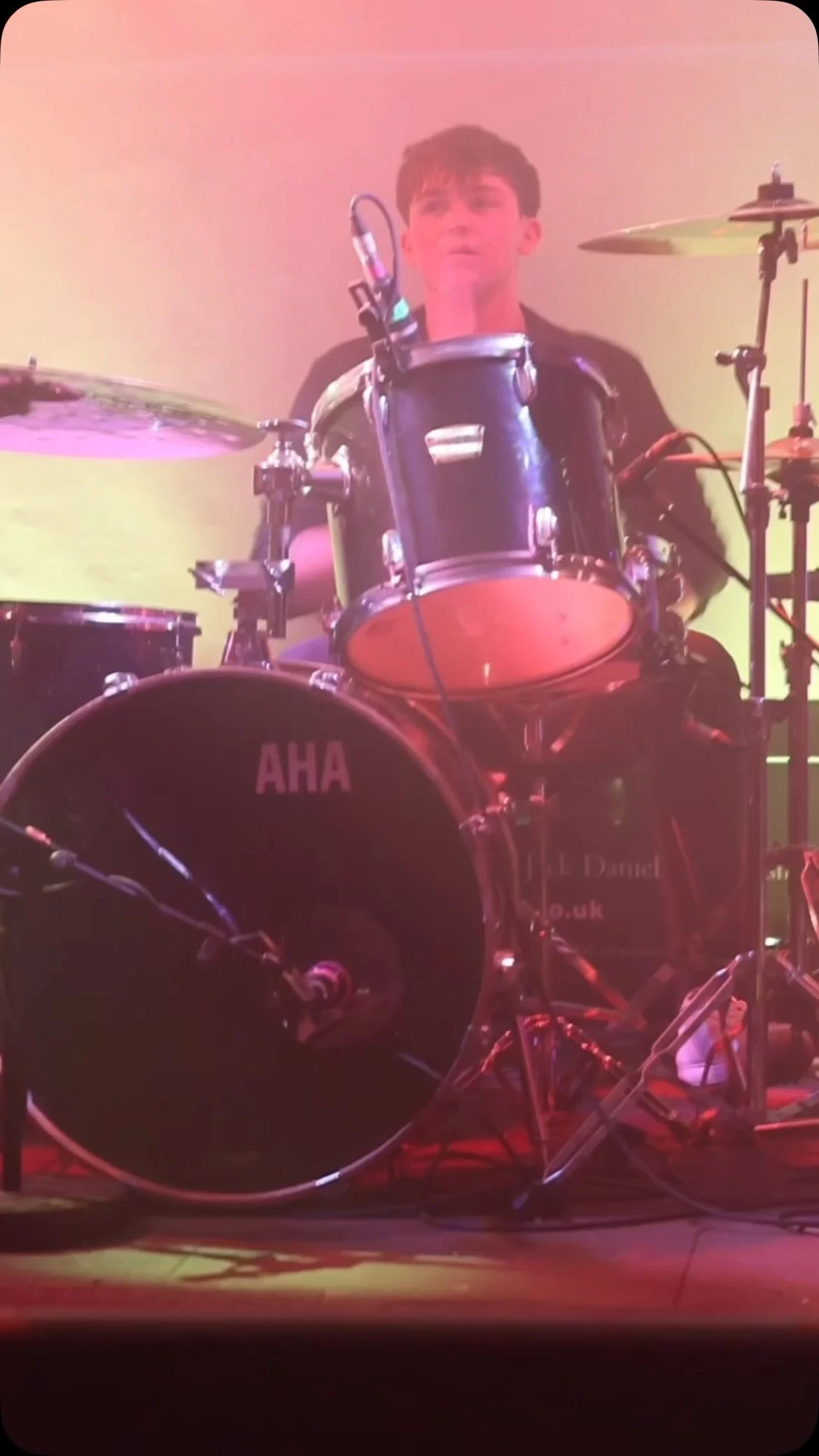
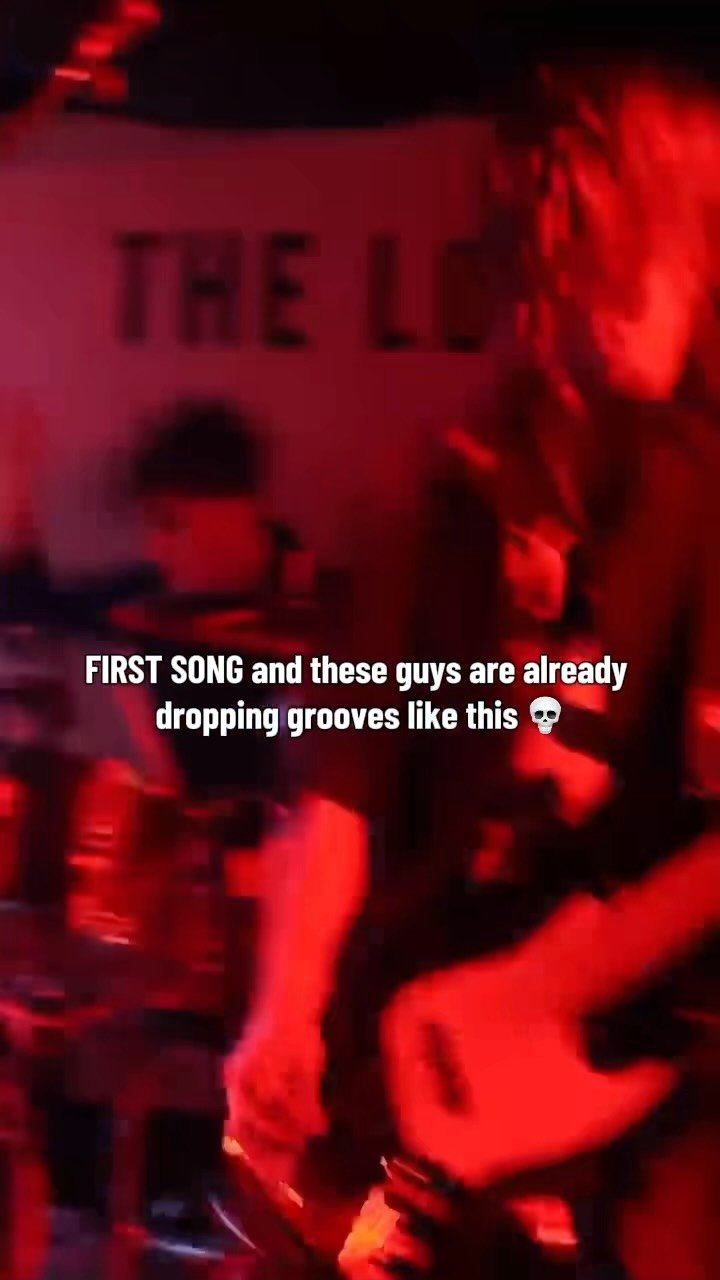
TikTok Promo Snippets
TikTok Content and Audience Development
TikTok played a different role from Instagram within the campaign. Instagram remained our main platform for direct promotion, formal announcements and communication with the band’s existing audience. TikTok was used more broadly as a discovery platform, helping Intrusive reach people who were not already following the band.
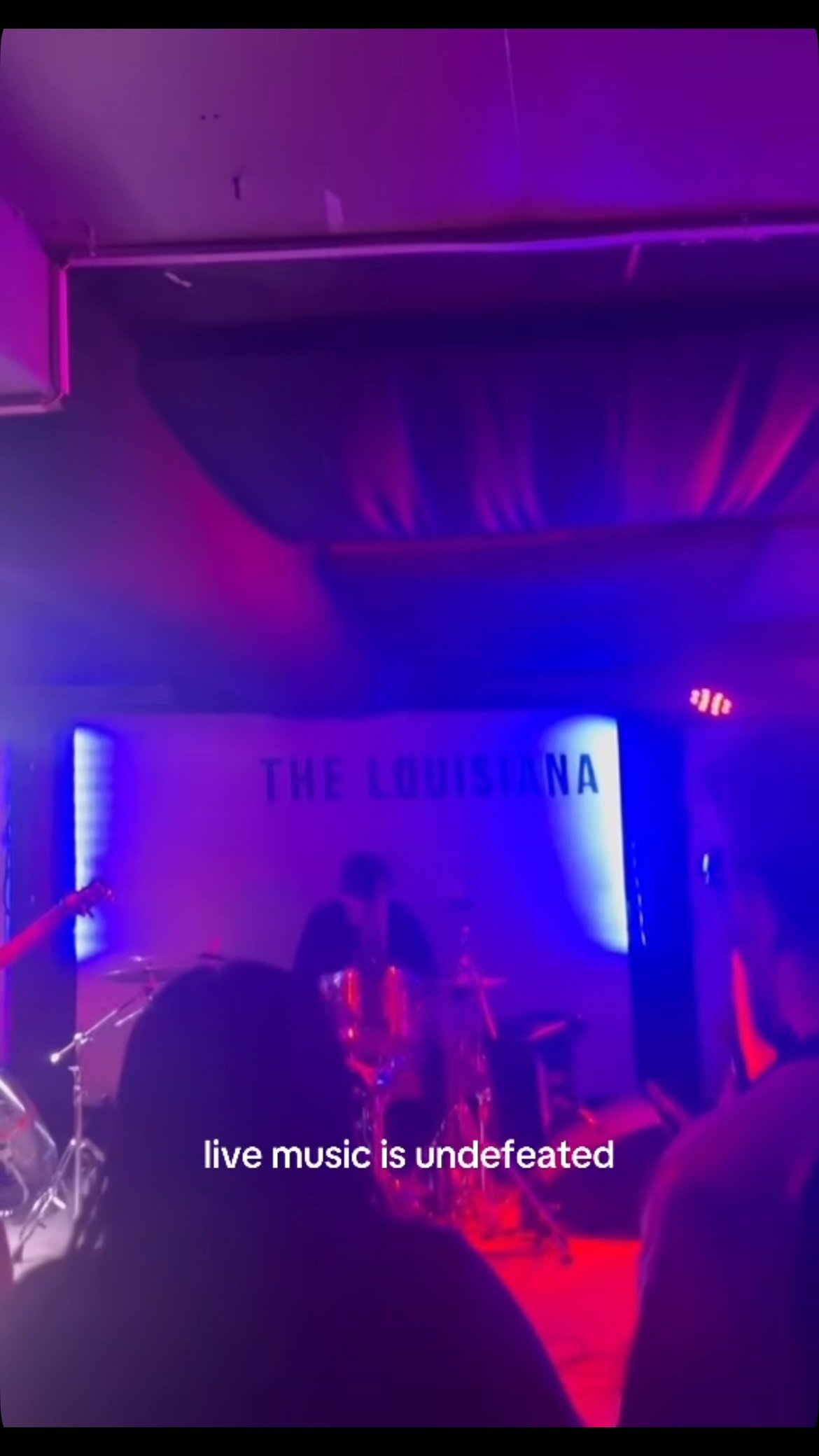
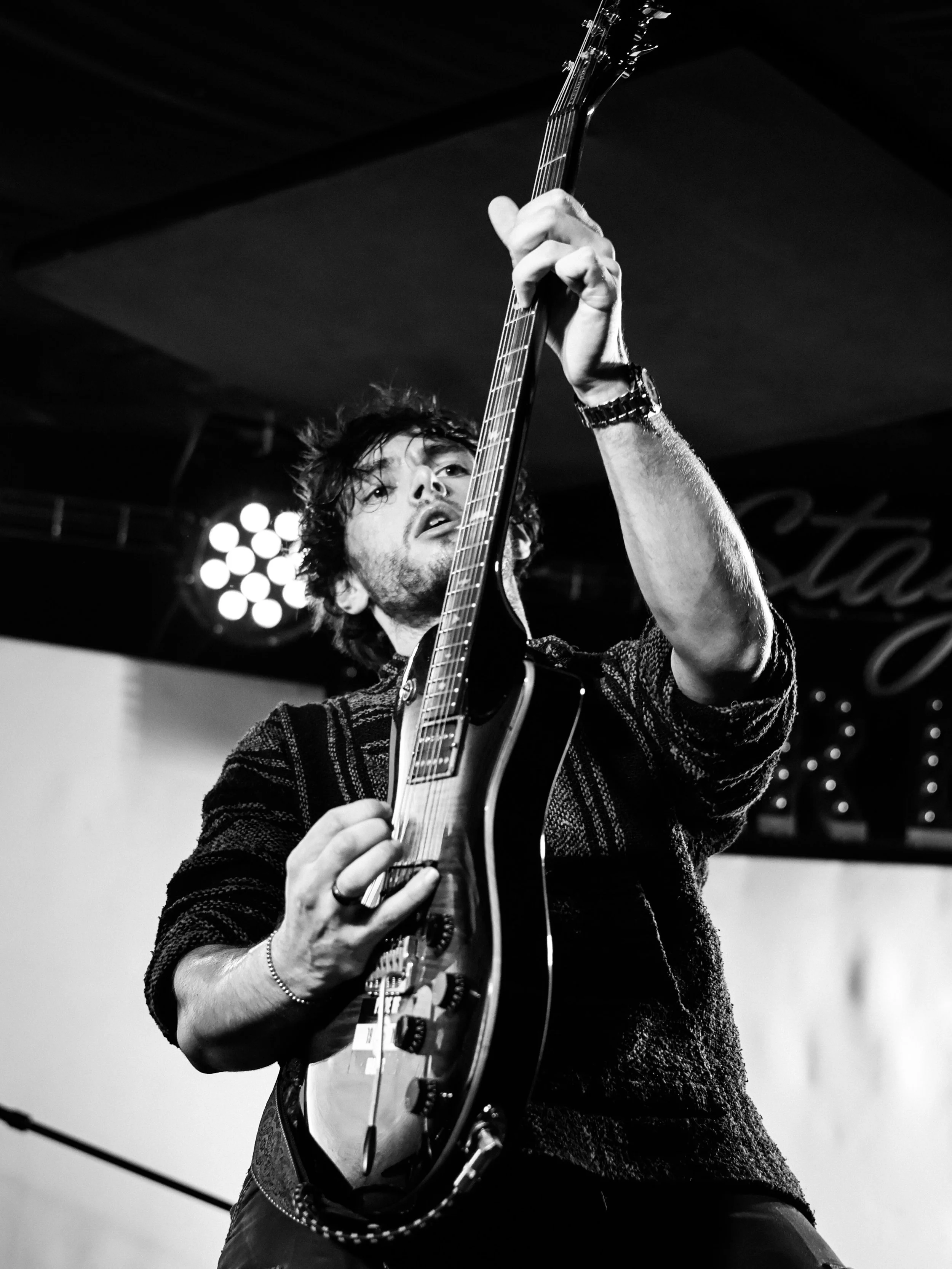
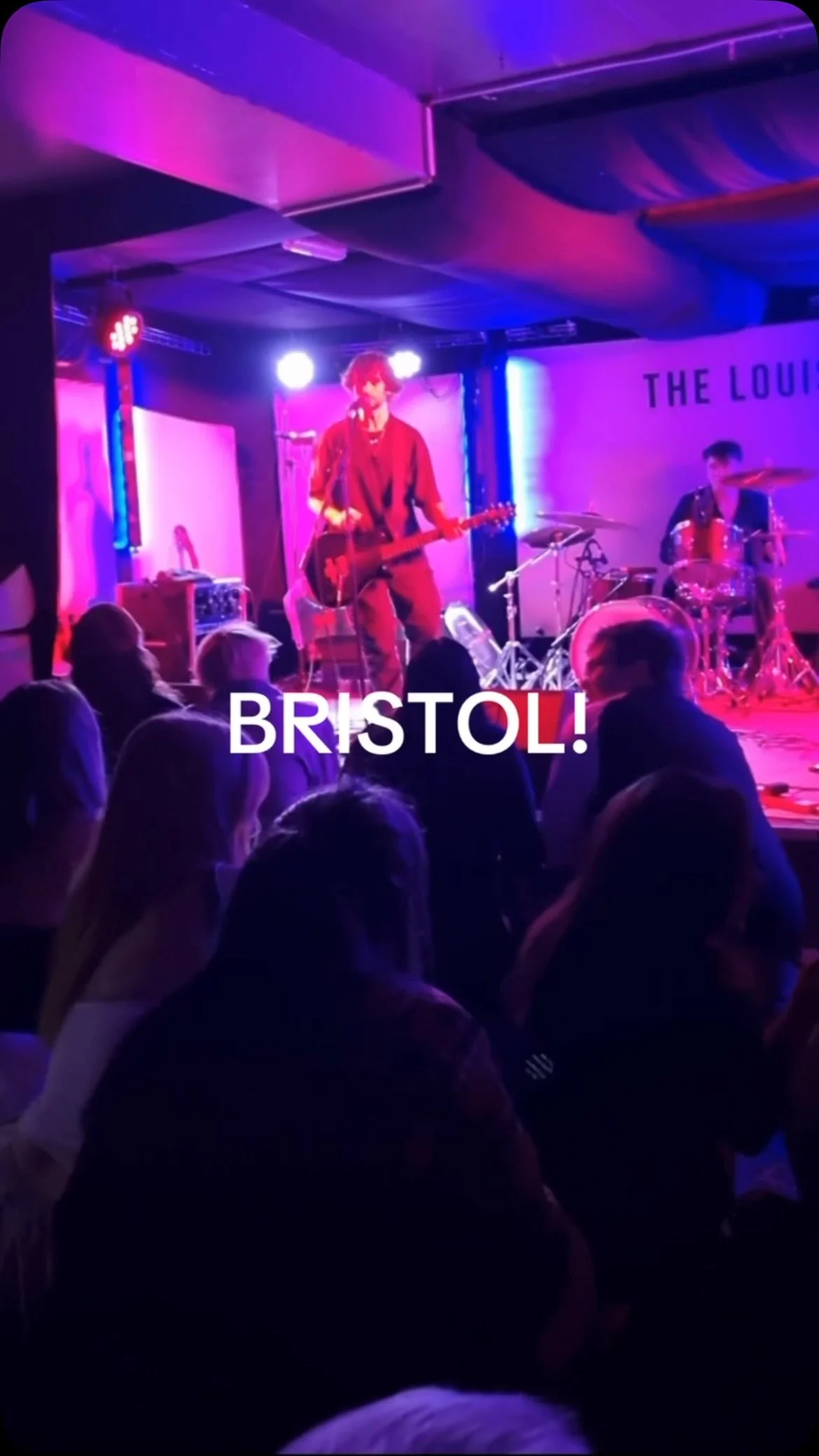
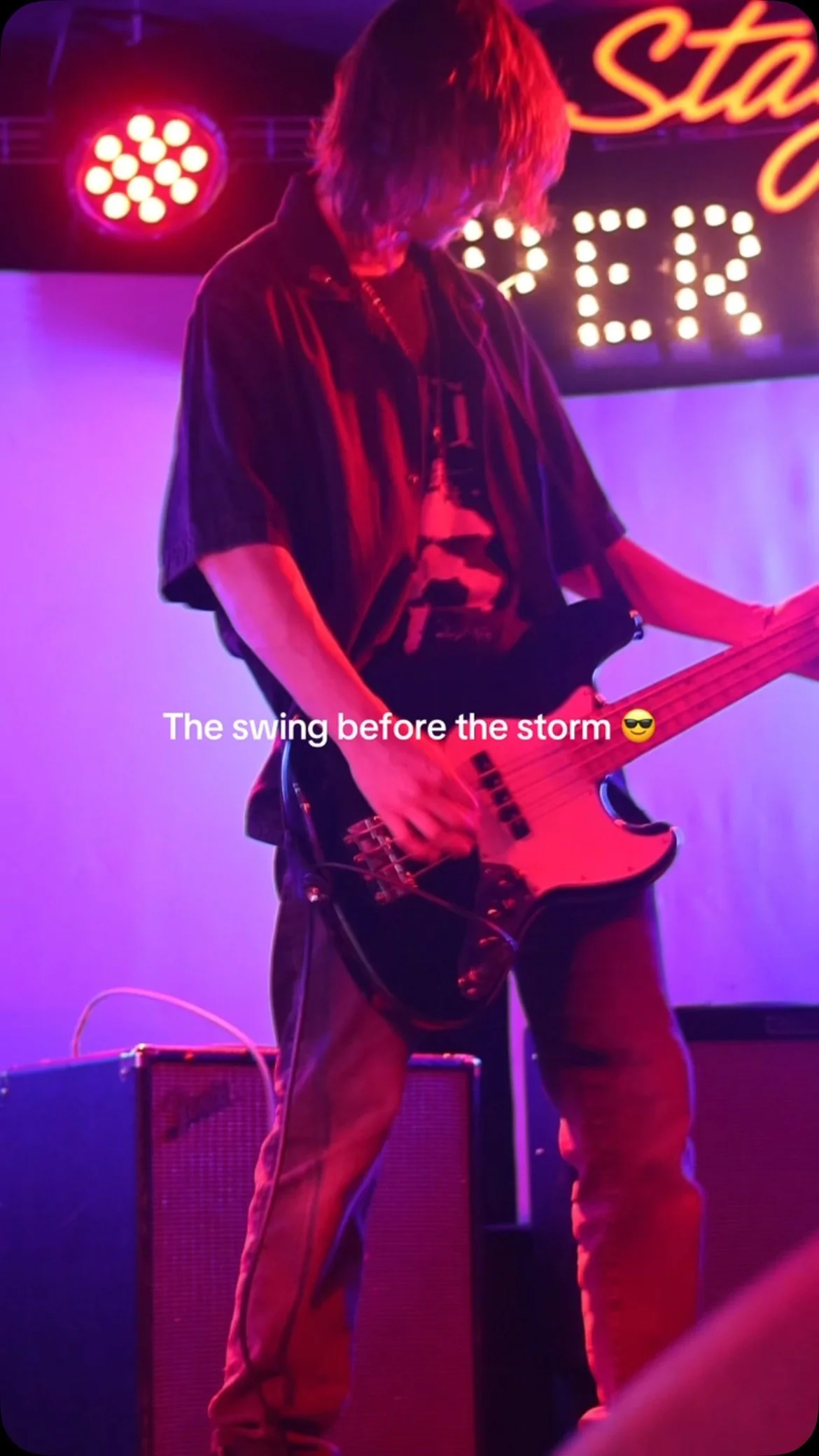
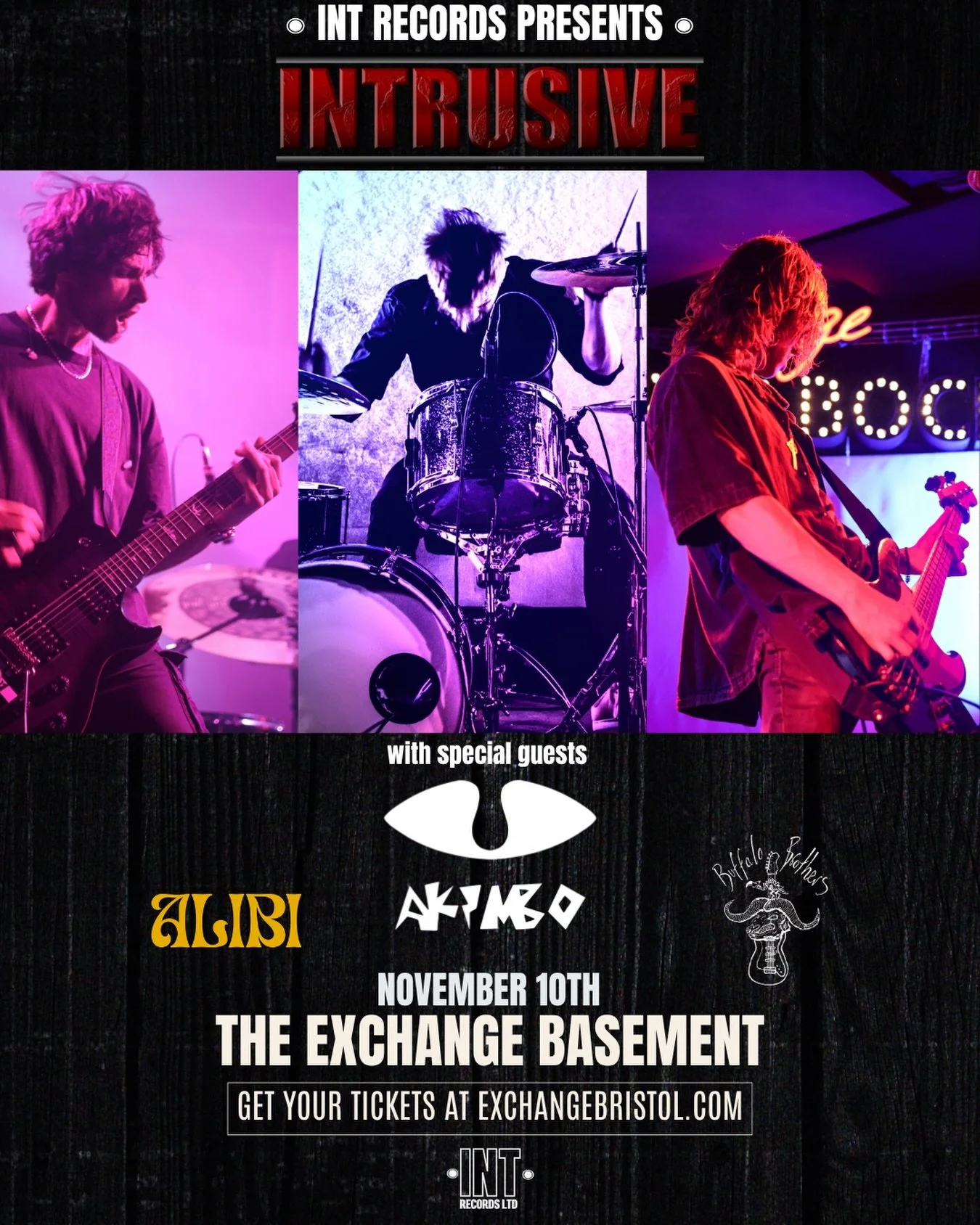
Our TikTok output combined rehearsal and recording footage, live clips, humorous moments, campaign teasers and more general personality-led content. Not every video directly promoted the album or showcase. Some were created primarily to attract new viewers, encourage engagement and build familiarity with the band, creating a wider audience for later promotional content.
Because the TikTok profile contains a large amount of material produced both during and around the campaign, the buttons on this page link directly to selected videos that are most relevant to the Major Project. This prevents the evidence from becoming lost among unrelated audience-building content and allows key examples of recording, live activity and release promotion to be accessed immediately.
The linked videos represent some of the strongest examples rather than the complete TikTok output. Together, they demonstrate how project-specific promotion was incorporated into a wider short-form content strategy intended to increase the band’s visibility and attract new followers without making every upload feel like a direct advertisement.
Instagram Campaign
Throughout the project, Instagram acted as Intrusive’s primary visual platform. It documented rehearsals, recording sessions, live performances, showcase promotion, the album announcement and post-release activity. Rather than using the account solely as an advertising space, we treated it as a continuous public record of the campaign and a way of maintaining a consistent identity around Intrusive and One That Got Away.
The content combined promotional graphics, performance footage, rehearsal material and informal behind-the-scenes posts. This balance allowed us to present the band professionally while retaining direct and personal communication with existing followers. Instagram was used to build interest in the Louisiana showcase, announce the album shortly before release and direct listeners towards the finished record once it became available.
The live feed displayed here places the campaign within the wider development of the band’s online presence. The individual posts included on this page have been selected as some of the strongest examples from key stages of the campaign. However, they represent only a small proportion of the material produced. Further posts, Reels, Highlights, performance footage and behind-the-scenes content can be viewed through the linked Instagram profile. Embedding every item here would make the project page unnecessarily repetitive, so visitors are encouraged to explore the full profile for a broader record of the campaign.